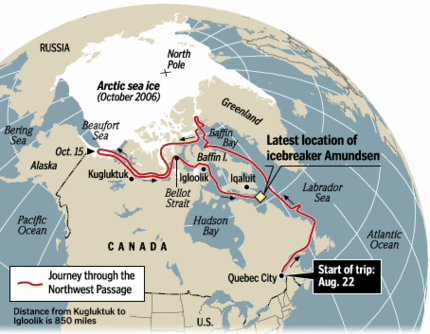
Map of the (Canadian) Northwest Passage
In a symbolic move towards securing Arctic sovereignty, the Canadian House of Commons today passed an amendment renaming the Northwest Passage the “Canadian Northwest Passage.” The move was nearly unanimous. Some Inuit leaders initially expressed reservations with the renaming until House members agreed to allow for a provision that would permit an official Inuktikut name alongside the English-language name. The Inuit, who have plied these waters for thousands of years, traditionally refer to the passage as “Tallurutik,” meaning “linear landscape.”
The renaming of the passage could prove controversial. Canada considers the passageway to be internal waters, while most other countries – including the United States – view it as an international strait. The dispute between the two North American countries came to a head in 1985, when a U.S. coast guard icebreaker passed through the waters without having asked for Canadian permission. Consequently, Canada declared the Northwest Passage to be “internal waters.”
The symbolic move also follows on the heels of Foreign Minister Cannon’s speech on November 23 to the Economic Club of Canada.
As quoted in the Globe and Mail, Foreign Minister Cannon remarked,
“Canada is in control of its Arctic lands and waters and takes its responsibilities very seriously… This is why we react so strongly when other nations like Russia engage in exercises and other activities that appear to challenge our security in the north and undermine the co-operative relationship that we must, and should, put in place.”
He called Canada an “energy superpower.” Of course, following last week’s release of the True North report on the state of Canadian Arctic infrastructure, global warming could both open up oil fields and weaken the infrastructure needed to carry out industrial activities – thus jeopardizing Canada’s supposed “energy superpower” status.
Michael Byers, Canada Research Chair in Global Politics and International Law at the University of British Columbia, writes in the Globe and Mail that he can “hear the laughter in the State Department.” He says that the Northwest Passage is “already Canadian,” and that the newest attempt to declare it as such will only backfire. Nomenclature does little to convince other that a territory or waterway belongs to that country: witness the back and forth between South Korea and Japan over the “Sea of [insert country here].”
News Links
“Arctic sea route to be renamed ‘Canadian Northwest Passage’,” Vancouver Sun
“Canada an ‘energy superpower’ in the Arctic, Cannon says,” Globe and Mail
“The Northwest Passage is already Canadian,” Globe and Mail
