
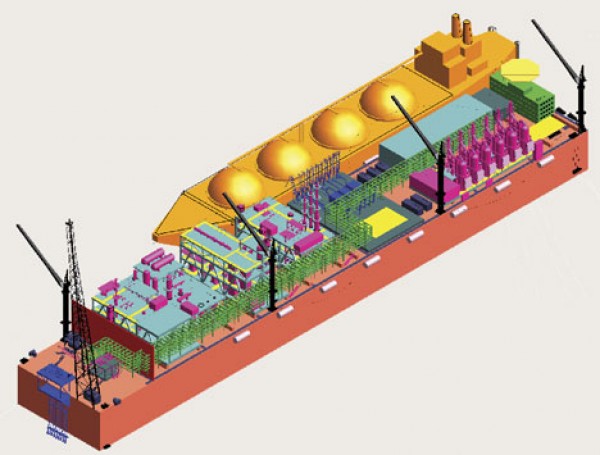
Floating LNG Facility ; Source: Statoil.com
Shanghai-based Wison Offshore & Marine Ltd. announced on June 1, 2012 that it had been awarded a contract by the Exmar Group for the engineering, procurement, construction, installation and commissioning of the world’s first Floating LNG Liquefaction, Regasification and Storage Unit (FLRSU), according to gCaptain.com. The facility will be used by Exmar and located on the Caribbean coast offshore Colombia and supplied with natural gas by pipeline from the onshore La Creciente field, located in the Lower Magdalena Valley Basin.
This is a newsworthy event in the LNG (Liquefied Natural Gas) industry because it is the first time that a floating liquefaction unit is moving from concept to commercial reality. What are the advantages of those floating LNG facilities over conventional liquefaction plants?
First off, there is an obvious advantage in tapping offshore resources. In addition to the ability to station the floating vessel directly over distant offshore fields and thereby saving on a costly subsea pipeline to shore, it allows the operator of the facility to move the production facility to a new location once a field is depleted. This would also allow energy companies to exploit smaller fields and now earn a realistic return on investment. Other cost savings are to be expected during the construction phase for the required marine and loading facilities which often end up costing billions of dollars.
Finally, in a world full of risk it can significantly reduce the security and political risk (inter alia, environmental regulation and permits) involved in choosing a land-based site for LNG export facilities in African countries (Nigeria, Angola and Mozambique) and countries in the Middle East as well as South America. The US should contemplate something like this along the East Coast for export to Europe, and along the West Coast for export to South America (Chile) and Asia.
