


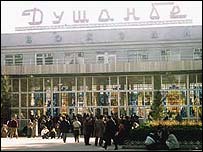

The most famous one in 2003, during the Central Asian Games, hosted in Dushanbe. Officials made one public service announcement, while residents and visitors continued to get sick. Tajikistan does better with this obligation now, because they are reporting that:
Right now, in Kulyab, Tajikistan, there are 62 confirmed cases of typhoid, and 17 more in outlying areas of the township.
The culprit, according to IWPR, is aging water systems, with pipe first laid in the 1930's under Soviet management, and only partially revitalized in the 1970's.

Much of the typhoid incidence in Tajikistan is also due to insufficient chlorination of water. The Water Quality & Health Council has a relatively short article on why chlorine is considered optimal for water purification: the main point appears to be that chlorine not only kills existing bacteria such as Salmonella and E. coli, but also has a residual antibacterial affect.


Insufficient or inconstant power to municipal water systems creates another problem in maintaining water purity. When pumps are sometimes stopped, water does not flow, and untreated water slips into treated water. Therefore, work toward Tajikistan's energy security should also be understood as work toward water security as well.
Photos & Diagrams: BBC; Sanger Institute; Greener-Industry.org.