


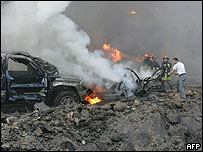

In February, 2005, a suicide bombing killed Rafik Hariri and 22 others in Beirut. Hariri had opposed Syrian intervention in Lebanon and his murder sparked protests against Syria. As a result, Syrian troops were coerced into terminating its 29-year presence in Lebanon. The Hariri assassination also stoked divisions in the Lebanese government. Violent conflicts have erupted between the Western-backed government of Prime Minister Fuad Saniora and the opposition led by pro-Syrian Hezbollah.
U.N. investigators have identified a number of suspects who either took part in or knew of the plot against Hariri. Serge Brammertz, the Belgian prosecutor for the United Nations, did not issue the names of any suspects in his latest report to the Security Council, though he did express concerns that recent civil conflicts in Lebanon may inhibit his investigation. Brammertz's predecessor, Detlev Mehlis, strongly implied in his investigations that Syrian and Lebanese intelligence officers were complicit in the Hariri assassination. Syria has denied any involvement.
The Netherlands hosts the international communities highest judicial bodies, including the International Criminal Court and the International Court of Justice. It also hosts the war crimes tribunal for the former Yugoslavia and the current trial for Charles Taylor, the former Liberian president.
The United Nations has also proposed the extension of the mandate for the United Nations Interim Force in Lebanon (UNIFIL), a 13,600 strong peacekeeping force. The formulation of the Special Tribunal is expected to take roughly a year.