



The Shaaban Intifada began in March 1991 after U.S. -led forces trounced the Iraqi military and forced them to withdraw from Kuwait. The Shi’ite rebellion, which corresponded with a Kurdish uprising in northern Iraq, was successful in seizing control of several cities and brought rebels within 60-miles of the capital, Baghdad. Many Shi’ites claim they were galvanized by outside support. U.S. President George H. W. Bush encouraged Iraqis to “take matters into their own hands” and “force Saddam Hussein to step aside” following the Iraqi defeat in the first Gulf War. Others cite the influence of Iranian agents operating in the southern provinces of Iraq, which are predominately Shia.
The intifada was crushed by reconstituted Iraqi forces under Saddam Hussein. The rebels site the ceasefire called by the first president Bush, which Shi’ites claim gave Saddam a free-hand to launch attacks against the intifada. Bush has stated that he did not advance to topple the Baathist regime out of fears of the collapse of Iraq into sectarian violence.
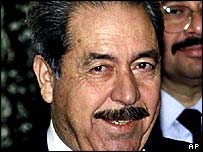
The trial will examine accusations of crimes against humanity “for engaging in widespread or systematic attacks against civilian populations.” Prosecutors have stated that many of the men, including al-Majid, had personally executed prisoners; “Majid used to come to detention centers, tie the hands of the detainees, and then shoot them dead … “
Al-Majid, and several other of the accused, have already been sentenced to death for violations of the laws of war and crimes against humanity for their actions in the al-Anfal campaign. Tens of thousands of Kurds were killed in 1998 in response to a Kurdish uprising. Many of the Kurds were killed using chemical weapons, giving al-Majid his nickname of “Chemical Ali.”