


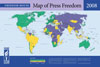
Just like Freedom House's overall Freedom Rankings, in this survey a nation is ranked either Free, Partly Free, or Not Free based on these three categories:
1. Political influence on reporting and access to information
2. Legal environment in which media outlets operate
3. Economic Pressure on content and the dissemination of news
Each nation was ranked on a scale of 0-100, with 100 representing complete government control over mass media, and zero indicating perfect freedom.
Kyrgyzstan– 70, Downward trend, government pressure on public broadcast media affecting the political environment
Turkmenistan– 96, Same score, only Burma and North Korea received a worse score, the report stated 'the government retained its absolute monopoly over all media, directly controlling not only media outlets, but also the printing presses and other infrastructure’
Uzbekistan– 92, up one point from last year, the report states that Uzbek authorities 'showed no respect for freedom of speech or of the press’
Kazakhstan– 78, two point increase, the report acknowledged widespread government control and the harassment of independent journalists and editors
Tajikistan– 77, the report criticized its treatment of journalists and the introduction of amendments criminalizing libel and defamation on the Internet
An overall poor showing for the whole region.
An ongoing story I came across recently exemplifies the region's problems with a free and secure media environment. It appears the government of Kazakhstan has blocked Radio Free Europe's (RFE/RL), an independent news and broadcast organization funded by the US Congress, website. RFE/RL President Jeffrey Gedmin at first thought it might be a technical problem, now, after the Kazak government failed to respond to several inquiries, suggests that this is a case of ‘deliberate interference.’ This shutdown does not only affect Kazak's population, but the people in Uzbekistan, Turkmenistan, and Kyrgyzstan as KazTelecom, the state telecom operator, is the key Internet service provider across all of CA.
This situation is getting serious as OSCE representative on media freedom, Miklos Haraszti, sent a formal letter to the Kazak government asking why the service has been interrupted and requesting that it be brought back right away. It is important to know that Kazakhstan stands to take over the OSCE Chairmanship in 2010 and has faced much criticism from many human rights group in the West who are against a country with such a poor record holding such an important position. This event is drawing fresh attention to Kazakhstan's repressive government, no doubt attention it does not desire. Haraszti uses rather strong language in his letter stating;
‘I am convinced that the state Internet service providers were informed by your government that interference in providing service would violate Kazakhstan's press freedom commitments.’ He adds that OSCE's Permanent Council Decision No. 633, states that participating states must pledge 'to take action to ensure that the Internet remains an open and public forum for freedom of opinion and expression.’
As of right now, no Kazak government official has publicly responded to the letter.
In the same report, Turkmenistan's government was criticized for harassing and intimidating various Radio Free Europe correspondents. In addition, Kyrgyzstan has a new media bill that some argue would crush any positive steps that have been taken since their 2005 popular uprising.
Freedom House's media survey and these recent events portray a region in the dark and one whose leadership wants to keep it that way.