


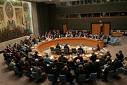
As Russian and Georgian forces continue to fight each other far beyond the confines of South Ossetia the diplomatic action has moved to the U.N. Security Council (Voice of America – US, Russia Trade Accusations at Security Council Over Georgia ):
At the rare Sunday session of the council, called jointly by the United States and Georgia, U.S. Ambassador Zalmay Khalilzad questioned Russia's motives in sending some 10,000 troops into South Ossetia in recent days to prevent Georgia from reasserting control over the Russian-backed breakaway region.
“Russia has claimed that its military operations were intended to protect its peacekeepers and the civilian population in South Ossetia,” said Zalmay Khalilzad. “Yet, its reaction goes far beyond any reasonable measures required to do so. Indeed, its escalation of the conflict has been the immediate cause of increased loss of innocent life and humanitarian suffering.”
Khalilzad said Russia's expansion of the conflict to another separatist region of Georgia – Abkhazia – and attacks on areas around Georgia's capital, Tblisi, “suggest other motives and objectives.” He also accused Russia of obstructing the withdrawal of Georgian forces from South Ossetia.
He said the United States has begun consulting with other like-minded members of the Security Council and would soon introduce a resolution calling for an immediate cease-fire. If such a resolution were strongly critical of Russia's role in the crisis, Moscow would likely use its veto power to quash it
It's not clear what Security Council action will accomplish in the face of an inevitable Russian veto other than raising the consensus that Russia should withdraw from Georgia.
How will the U.S. deal with this situation? Presidential candidate John McCain suggested his own plan of action (Politico – McCain warns Russians of “severe, long-term negative consequences”) today that no doubt will find a hearing in the Bush White House. This path starts with diplomacy and leads to a potential military clash between NATO and Russia for the sake of preserving the independence of the post-Soviet states. The neoconservatives will stay that it is vital for Europe and the U.S. to do so, and that we should not allow Russia to impose a new Iron Curtain.
Is there an alternative view? Yes, as always, some will find a way to blame the U.S. and suggest we do nothing at all. Justin Logan, the Cato's Institute's Associate Director of Foreign Policy Studies, takes this approach:
What this situation should highlight is the recklessness of the bipartisan American support before the recent Bucharest NATO summit for providing a Membership Action Plan to Georgia. The last thing the United States should be contemplating is expanding NATO, an alliance without a mission, to include a country with two unresolved territorial disputes with Russia. Further, there is reason to wonder to what extent such robust American support led the Georgian government to believe that they had American backing, should further problems with Russia arise.
The loss of life in any conflict, whether in Darfur or South Ossetia, is to be regretted. But American national interests call for restraint and discrimination, and in this case we must face the fact that the defense of far-away countries from much larger, more powerful neighbors who have permanent seats on the UN Security Council would be a dangerous venture indeed.
I suspect that the answer lies somewhere between a NATO vs. Russia conflict and a do-nothing response, but finding that middle-ground will be a job for the diplomats skilled in the art of talking while bullets are flying. I can't help but note that when the U.S. initiated regime change in Iraq we at least went to the UN and presented a legal case, and when Russia initiates regime change in Georgia, it just sends in the tanks. Some things, it appears, never change.