


During the past two weeks my mid-term exams at Georgetown University have consumed nearly all my time. After several papers, I’ve nearly finished my mid-terms with only one more to go in Economics for Latin American Studies… That said, I should be back on track writing frequently for the Mexico blog, along with Alejandro. 

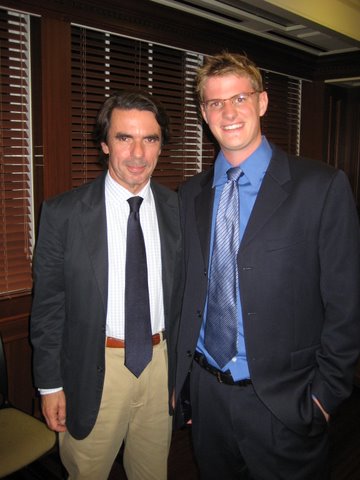
In this time I’ve had the opportunity to meet two heads of state that spoke about issues that can be applied to Mexico. First, President Jose Maria Aznar of Spain (pictured) spoke about common bonds between countries with Christian heritages and democratic values. In Spain, this centered primarily around immigration of African migrants. In the US, this would apply to Mexican migrants as well.
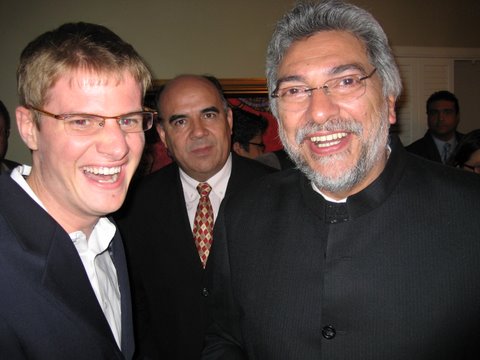
Second, newly elected President Fernando Lugo of Paraguay (below) spoke about cleaning up corruption and bringing honest reform to government. Lugo's case is particularly interesting, since he resigned as archbishop in one of Paraguay's poorest districts to run for President and clean up the country which is currently ranked #138 on Transparency International's Corruption Perception index. Mexico ranks 72 on this list.
As you’ve gathered, a lot is going on in the world of Mexico and more broadly Latin American Studies in Washington, DC these days. For example, one of my professors at the School of Foreign Service who teaches Latin American States and Societies, John Bailey, was interviewed in two major Mexican newspapers this week, Excelsior and El Universal. The first article in El Universal discussed how the Tec higher education system in Mexico is a reflection of “social warming”, that is, global interconnectedness and also the need to expand access to higher education within Mexico. The second article in Excelsior (featured in print, unfortunately not online) addressed the fact that narcoterrorism is now entering the media when describing the situation of organized crime and drugs, resembling an Aghanistan. Professor Bailey also touched on the need to create a political consensus to fight organized crime in Mexico, and that either President-elect in the US will support this initiative.
Mentioning the American Presidential campaign, I find intriguing that the issue of immigration reform has been put on the back burner for what I believe is more than a month. Surely this will be one of the pressing issues the next President faces, and I would have liked to see substantive discussion during the Presidential debates.
However, the two issues which are now dominating in Mexico are the financial crisis and organized crime. With the financial crisis pulling down markets worldwide, Mexico is surely to be affected. However, the degree to which the economy will suffer is difficult to determine at this point, and I believe very unlikely that it would approach crises seen in 1994 and 1997-8. So far the Mexican Central Bank (Banxico) believes the effects will be mixed. See commentary with the bank chief Elizondo Almaguer in Spanish here. Feel free to post a comment to see my further thoughts.
Organized crime continues to dominate the headlines in Mexico. Alejandro's last post noted that drug cartels have infiltrated senior levels of the government, and the gap between action and rhetoric seems to be widening. In connection with the scandal, the top Federal Police Commissioner, Victor Gerardo Garay, resigned. This week policemen were gunned down in Michoacan. Next Wednesday the Mexican Ambassador to the US will be coming to my department for a roundtable, and I am eager to hear his take.
Until then, we’ll wait for tomorrow's exciting US election news!