

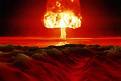

The Obama administration, reversing the Bush administration's limited interest in nuclear disarmament, is gearing up for early negotiations with Russia on a new treaty that would sharply reduce stockpiles of nuclear warheads. Secretary of State Hillary Rodham Clinton has notified Congress and her staff that she intends to get started quickly on talks with the Russians, who have voiced interest in recent weeks in settling on a new treaty calling for cutbacks in arsenals on both sides. The 1991 Strategic Arms Reduction Treaty expires at the end of the year. It limited the United States and Russia to 6,000 nuclear warheads each. The American stockpile is believed to be about 2,300 warheads, and the Russians’ even lower. Clinton's spokesman, Robert Wood, said the new administration was serious about negotiating reductions in nuclear weapons. A replacement treaty for START “will be put on a fast track,” Wood said.
The issue of nuclear arms reductions has not been high on the public agenda, there is the perception that arms treaties and disarmament happened during the Cold War and the world no longer faces the danger of nuclear annihilation. While it's true that the two nuclear superpowers did agree to diminish the size of their nuclear arsenals they still retain more than enough nuclear missiles to destroy each other and the world. Remember that during the Cold War it used to be said that the superpowers had enough nuclear missiles to destroy the world many times over; now, thanks to mutually agreed reductions and limitations, they have enough missiles to destroy each other and the world only two or tree times over. We should remember that when you are talking about nuclear doomsday, once is enough. If you don't accept the idea that nuclear armaments set at current levels still constitute a dire threat we can still accept the idea that the maintenance (and upgrade) of existing stockpiles pose a threat to world peace by undermining the nonproliferation regime – efforts to prevent the spread of nuclear weapons and weapons capabilities. Mohamed ElBaradei, Director General of the International Atomic Energy Agency, made exactly this point in commentary appearing in Suddeutsche Zeitung:
So the obvious question is: if leading world powers believe their security depends on having weapons that could annihilate our entire planet, and if they keep modernising and upgrading their nuclear arsenals and even conducting research into their actual use, how can we credibly expect other nations – in the name of maintaining international security – to refrain forever from seeking the same weapons?
His logic takes on greater urgency today as we learned about the release from prison of one of the great proliferators of the nuclear age – A. Q. Khan of Pakistan. Far from being a shamed criminal, he is a hero to his people. Also this week, North Korea was reported to be preparing to test-launch a ballistic missile and Iran launched a satellite . It seems clear then that a prudent nuclear policy would focus on arms reduction and nonproliferation in tandem. Now that we know that the Obama administration will take arms reduction efforts seriously we can look forward to learning what efforts they plan to make in the area of nuclear nonproliferation. For your further research into this extremely important issue I recommend the Nonproliferation website hosted by the Carnegie Endowment for International Peace as a resource for proliferation issues and analysis.