

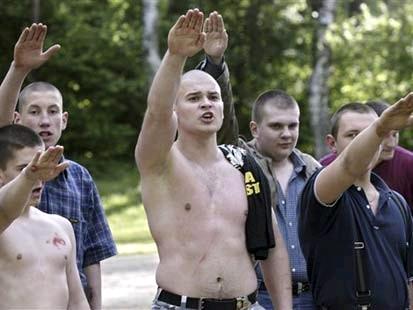

FPA Russia blog sometimes gives the Guardian's Russian man Luke Harding a hard (ahem) time, but hats off to him for today's chilling and well-researched investigation into rising skinhead and neo-Nazi violence.
Ultranationalist gangs, whose members are mostly in their early 20s or even younger, are responsible for over 300 brutal killings since 2004.
Harding talks about some of their grizzly crimes and speaks to a ring-leader. Skinhead attacks are nothing new in post-communist Russia, and have been covered widely, but what is interesting is how the far right has emerged as a potent and scary new political force:
Over the past eight years Putin has squeezed out virtually all independent political activity in Russia. There are now only two opposition movements left, Dyomushkin [a neo-Nazi leader] argues – the far-right and the democratic liberals. Dyomushkin is scornful of the liberals – “many of whom are Jews” – but agrees they share anti-Kremlin ideas. But while the democrats are weak, divided and marginalised, the nationalists enjoy much broader support – including that of elements deep inside Russia's powerful bureaucracy and law enforcement agencies. (Both Ryno and Skachevsky had links with a former far-right deputy in Russia's Duma, or parliament. Officially they were working as his parliamentary researchers.) Dyomushkin describes Putin's Russia as a “police state”, which has retained the worst aspects of the Soviet Union while getting rid of the good bits. “It may seem a paradox, but our movement is now fighting for freedom. It is the nationalists who are fighting for freedom of speech and assembly. Nothing else has the strength to do this. Everyone else is frightened,” he says.


Another interesting part of the article is when the mother of a gang member hypothesises about the possible origins of ultranationalist crime:
According to Yelena, attitudes changed after the collapse of the Soviet Union. “My generation was a Soviet one. We were internationalist. We have Armenian relatives. My brother even married a Japanese woman. The problem is with this new generation. They don't understand the difference between nationalism and patriotism. They confuse the two.”
Unfortunately, for all the article's reporting leg work, it stops short of a serious investigation into the roots of the problem. Yet Harding glances at some of them: an influx of migrant workers from the former Soviet republics, and the poverty and wounded pride of the gang members.
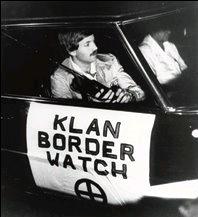

Indeed, the fall of Communism witnessed a great rise in xenophobic violence all over, from Eastern Germany (beatings and killings of Vietnamese workers) to Russia (reprisals against Uzbek and Tajik guest workers, or gasterbeiters).


(Image: The Exile's satirical take on Uzbek guestworkers)
What is most painful about these attacks is that, unlike Mexicans in the US, the victims used to be seen as integral parts of the society (eg. many ex-Soviet guest workers had been educated or grew up in Russia) and in very rapid order have come to be seen as maligned ‘others’. Not only are they threatened by gangs, but also many are tricked into slavery. And this happens not only in Russia, but all over the former USSR. How this came about is a very pressing subject worthy of serious examination.