


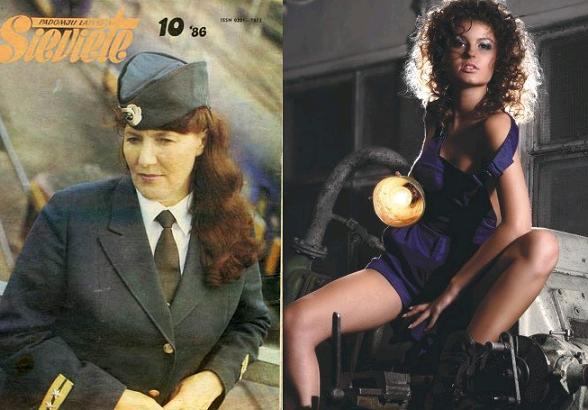

Not everyone in America or England knows this, but today is International Women’s Day, an official holiday in Russia.
Ironically, while the USSR had long prided itself on its feminist stance and some well-deserved progress in gender equality, Women’s Day often felt more like a mix of Valentines and Mother’s day, an orgy of flowers, cards and chocolates very different from the sort that IWD originator Clara Zetkin, the revolutionary feminist and free love advocate, may have had in mind.
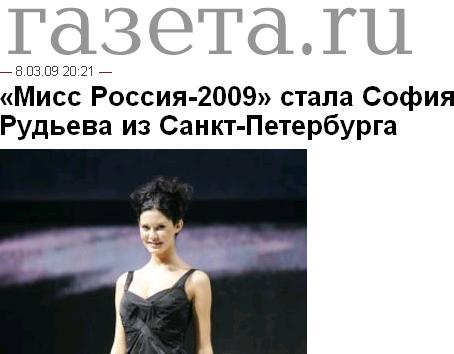
Fast forward to today, when the popular online paper Gazeta ru’s headline announces: Sophia Rudyeva has been crowned Miss Russia! That’s right, International Women’s Day has become the venue for a beauty contest, showing just how much has changed since those days.

It seems that women in Russia have been hurled straight from the lipstick-free Soviet Victorianism of female discus throwers and into a post-modern culture which promotes female sexualisation, such as lap-dancing, as a form of feminist empowerment.
“”If we had no sexual harassment we would have no children” –Russian judge in a 2008 sexual harassment ruling.
Indeed, despite leading most Western countries in their share of senior management jobs (42% compared with a worldwide average of 24%) Russian women frequently do things that would be considered mediaeval if not illegal in Anglo-American workplaces, such as taking part in office beauty pageants and posing for glamour calendars.
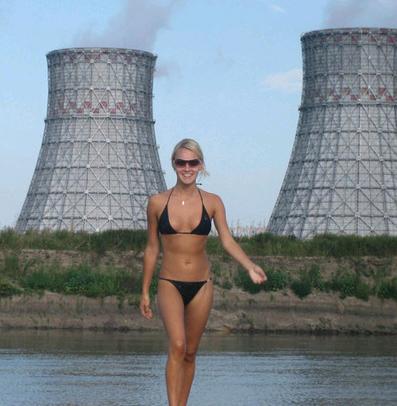

Sexual harassment is so rife that the Daily Telegraph had reported that “100 per cent of female professionals said they had been subjected to sexual harassment by their bosses, 32% said they had had intercourse with them at least once and another seven per cent claimed to have been raped. 80% of those who participated in the survey said they did not believe it possible to win promotion without engaging in sexual relations with their male superiors”.
This has gone hand in hand with an explosion in human sex trafficking from the former Soviet Union (though Russia has recently been ‘promoted’ from exporter to exporter-importer status).
In fact, another sad headline on International Women’s Day, in Israel’s Haaretz, reads: “Tel Aviv police smash international human trafficking ring”. The criminals “located hundreds of women from villages and small towns in Russia, the Ukraine, Belarus, Moldova and Uzbekistan, and manipulating them in to traveling to Israel…forcing the women to engage in prostitution in clubs and brothels, under threat of violence”.
In spite of these news, or maybe because of them, there are heartening indications that Russian women are becoming more vocal and political. According to a survey by the All Russian Centre for Public Opinion Research (VTsIOM), while 8% more Russians than in 2003 believe that women have as many rights and opportunities as men (11% fewer believe that men have more) 6% more people than in 2005 feel that there are not enough women in government.
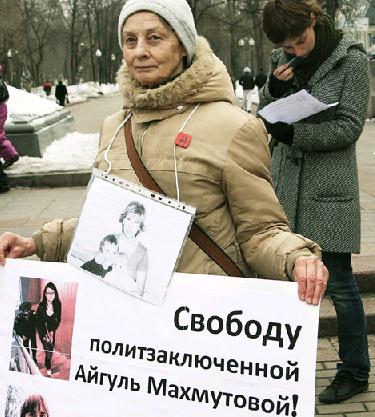
In Moscow yesterday, women demonstrated in solidarity with female political prisoners such as journalist Aigul Makhmutova and National Bolshevik Tatiana Harlamova.

It was also announced that Hillary Clinton will honour Vernokia Marchenko, leader of the “Rights of Mothers”, an NGO which investigates & exposes peacetime deaths in the Russian army, with the International Women of Courage award.
But while all is not doom and gloom for Russian girl-power, as with much of Russian progress, it’s often a case of one step forward, two steps back.
For example, I was very excited to hear that a group of Communist Party activists is proposing a monument to Lenin’s largely forgotten mistress Inessa Armand, a major revolutionary figure in her own right.
Great, I thought: bringing back some of the edgy political-feminism of the original Women’s Day! Until I saw a banner below the story that reads:
“Women and girls of Russia: follow the example of the beloved of the great Lenin!
Support your husbands as Comrade Krupskaya did!
Fight selflessly for your beloved as Comrade Armand did!”.