


The holocaust drama The Reader edged out Waltz with Bashir, a film about Israel’s invasion of Lebanon, for the Oscar because “Hollywood likes its Jews… hunched over and dressed in rags”, not waging morally ambiguous wars, Bradley Burston wrote in Haaretz.
Similarly, America likes its Russian artists defecting from their home country and condemning its leaders, not supporting it and working with them.
How else to explain Arthur Lubow’s bizarre cover story in Sunday’s New York Times magazine, about the acclaimed Russian-Ossetian conductor Valery Gergiev?
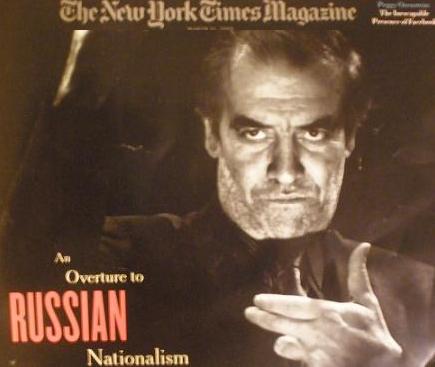
Superimposed on a scary black and white photo of Gergiev, piercing of eye and brooding of brow, a sophomoric pun thundered: “An Overture to Russian Nationalism”.
“What does it mean to wield cultural power in an increasingly autocratic state?”, the teaser demanded. And that was just the magazine cover!
The inside headline, “The Loyalist” (only a pejorative when applied to non-Americans?) was titillatingly subtitled: “Can Russian music be distinguished from Russian power?”
But like a trashy teen movie that promises hot unhinged sex but delivers only a cheap tease, Arthur Lubow’s piece jettisoned the conspiratorial pitch after just a few decidedly soft-core paragraphs.
You see, Gergiev performed Shostakovich’s Leningrad symphony in the ruins of the South Ossetian capital, Tskhinvali, in the wake of the Russian repulsion of Georgia’s offensive there last summer.
He thereby insolently condoned Russia’s actions when “Western observers…condemned Russia’s invasion of Georgia as a return to the hegemonistic (sic) ambitions of the Soviet Union, [and] wondered whether, in his use of the Leningrad Symphony, the conductor had lost his send of proportion.
Never mind that those actions were later vindicated – including by the New York Times itself – as a reactive response to Georgian adventurism.
And never mind that Gergiev – himself an Ossetian, and with an Ossetian wife – might be permitted some ‘disproportion’ in his response to the devastation of his homeland by Georgian troops. (To take up a favoured American analogy, what would Lubow have done if he were the conductor at the Met and New York had just been bombed by the Canadians?)
How else is Gergiev complicit in Russian autocracy? Well, he and Putin “have been friends since 1992”.
And that’s where the trail grows cold. Why would a conductor try to cosy up to an authoritarian president? Surely there is some nefarious conspiracy? 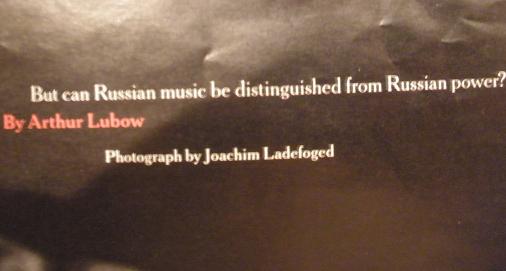

Alas we learn, in the same article, the very prosaic and pragmatic thread tying Gergiev to the Russian premier: “they share a deep attachment to St. Petersburg, and Gergiev has relied on Putin’s support for his threater”.
That support has been far from trivial: “By meeting with Putin and two cabinet ministers, he received approval for the [$500 million] expansion” of the Mariinsky theatre.
Speaking of his relationship with Putin and Medvedev, Gergiev says: “It is not personal, this is in return for that. They understand the importance of the Mariinsky”.
Hardly an autocratic cabal then.
And yet, even as the article mentions the comparative stinginess of Yeltsin, who was deaf to the cries of a Mariinsky theatre on the verge of post-Soviet collapse and reluctantly threw Gergiev $20 million after much pleading, it continues to question the reasons behind a theatre director’s loyalty to a very supportive patron.
Perhaps Gergiev’s nationalism lies less in politics than in his repertoire?
That reasoning also falls flat. We read that Gergiev has been refreshingly and consistently apolitical, free-spirited, and above all, Western-orientated in his choices.
In fact, Gergiev first began the staging of foreign operas in their native tongues, something unheard of in Russian theatres prior to his tenure at the Mariinsky’s helm. “His production of Parsifal, the first time that Wagner’s final opera was performed in the German language in Russia, is one of his signal achievements”.
–He both enthusiastically staged works that were suppressed in Soviet times, such as Stravinsky, and rehabilitated the overly political pieces that were cast aside as vulgar propaganda after 1991, such as ‘Zdravitsa (Toast to Stalin)’.
–He was the first Soviet musician to sign with a major Western label – Philips, in 1988.
–He is currently the chief conductor at the London Symphony Orchestra.
To any objective observer, such a solidly cosmopolitan CV should easily demolish any charges of nationalism and vindicate Gergiev’s view that “he is resurrecting great Russian music regardless of its political content”.
But not to Lubow, who steadfastly refuses to give up the ghost.“This is itself a political position”, he proclaims with the doggedness of a 9-11 truther, which “can serve the purpose of ultranationalists”.
What?!! I’ve lost you there; where did ultranationalists suddenly come into all this?
The entire article is written in this vein: an otherwise competent and well-researched work of journalism unnecessarily pieced together solely by cheap innuendo and guilt by association.
Having run out of any facts of Gergiev’s ‘dark side’, Lubow drops such nudge nudge wink wink suggestions as “He is a Shostakovich personality, not a Bellini personality. In other words, he responds to epic power, not delicate trills”.
You see?? EPIC POWER! AUTHORITARIAN power. And is it any coincidence that POWER and PUTIN both start with P and have 5 letters? I think not…..
Or this vignette, when Gergiev gets annoyed at being stuck at Heathrow airport: “His was not the mien of a conductor whose bassoonist had flubbed a solo; it was more the way Czar Nicholas might have reacted to the news out of Port Arthur during the Russo-Japanese War”.
Now it’s obvious!! Gergiev –>Nicholas II –>War with Japan –> Pearl Harbour –> 9-11 –> Gergiev wants Putin to nuke America!
What is most mystifying about the article, however, is the author’s irrational attachment to a hyperventilating Gergiev-Putin-Ultranationalism conspiracy theory even as his own factual reporting consistently disproves this flimsy allegation.
Had he not read his own piece?
Or can the US media just not stomach the sight of a Russian composer staying on in his country, being successful in the West without defecting? 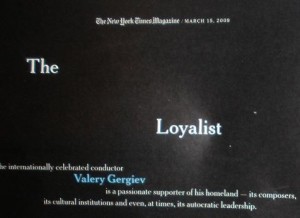

In fact, reading this article, it is Russians who should suspect a conspiracy.
A pattern begins to form: Stravinsky, Solzhenitsin, Nabokov, Rostropovich, Vadim Repin and Evgeny Kissin, who defected, are much more loved in the West than Prokofiev, Sholokhov, Gergiev,Gorky and Svetlanov, who didn’t.
It begins to seem that Gergiev is criticized and smeared not for some nefarious link to Putin, but because of his achievement and patriotism. Is what really bothers Lubow the fact that Gergiev put an end to the debilitating trauma and brain drain of the 1990s, when talent “was leaving the country like water pouring through a hole in the dyke”? That he has put Russian music back on the map with a vengeance? That he stayed behind?
Ironically, articles like this make the best fodder for the real ultranationalists who want to prove precisely that the West wants to bring Russia to its knees.
In his Haaretz piece, Brad writes that Hollywood should realise that Jews are not “cutesy, comedic Yiddishers nor noble, chiseled, ascetically moral kibbutzniks. They bear as much resemblance to Zohan as Adam Sandler does to Tzipi Livni. Israelis are complicated, angry, unhappy, family-oriented, insular, often flawed human-beings”.
Just so, it’s time for Russia watchers to come to terms with the new reality of Russia; no longer a vanquished foe, a hapless victim, an apprentice, a blank canvas, a human experiment, a failed state, or a source of brains and female genitals.
Like today’s Israel, today’s Russia is complicated, assertive, angry, healing, creative, proud, forward looking, and contradictory. But above all, it is a state with its own destiny for its people, outside of Western control.
Get used to it!