


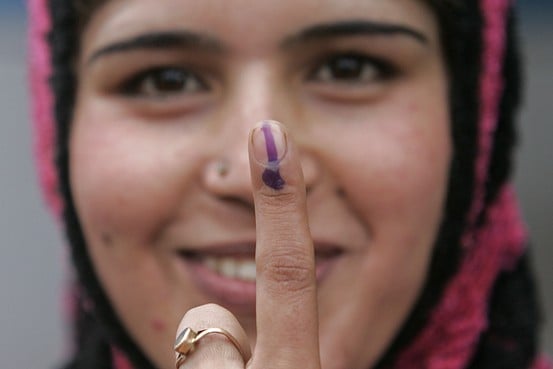

Last Thursday, Indonesians headed to the polls and today India’s election gets underway. With South Africans voting next week, we are in the midst of an election season for the world’s rising powers. Results of the upcoming ballots will have international implications.
Here is a rundown of several critical elections this year.
Indonesia – April and July
Voters marched to the polls last week in the world’s third largest election. Candidates for the 560-seat parliament are selected by 171 million registered voters from over 900 inhabited islands. This is the third election since the fall of Suharto’s dictatorship in 1998 and by most accounts “democracy is thriving.” The April parliamentary elections come ahead of the presidential vote in July. Candidates for the presidency must represent a party or coalition of parties that won over 20 percent of the seats in parliament or 25 percent of the popular vote.
President Susilo Bambang Yudhoyono is on course for re-election. If exit polls and preliminary figures hold up, his Democratic Party will take first place among the contesting parties. Allegations of fraud were heard, but the results are unlikely to be nullified or changed. Attention now turns to who the candidates and their running mates will be. If no one receives 50 percent of the vote in July, a run-off will be held in September.
India – April-May
The world’s most populous democracy stretches its general election over four weeks. 714 million people are eligible to vote (100 million for the first time) and 5,500 politicians from over 1,000 political parties are vying for 543 parliamentary seats. Voting is staggered in five stages and the results will not be announced until mid-May.
The economy, national security and local issues are influencing votes and the outcome is far from certain and difficult to predict. The Congress Party, Bharatiya Janata Party and Third Front are all possible victors, but the declining power of major parties and rise of small, local and regional parties will influence the government’s formation and stability. A coalition headed by Congress is the most likely result, as no party seems poised to win enough seats to command a majority. If Congress is able to form a ruling alliance, Manmohan Singh will remain prime minister (although Rahul Gandhi, heir apparent in the Gandhi-Nehru dynasty, could soon take the helm).
For more, see a backgrounder on India’s electoral politics produced by the Council on Foreign Relations.
South Africa – April
The African National Congress has governed South Africa since the end of apartheid in 1994 and the party is essentially assured victory in next week’s parliamentary election. The Democratic Alliance and Congress of the People, a recently formed party of ANC dissidents, are competing in the election but the ruling party expects to win easily. Some fear that the country’s democratic miracle is fading.
The new parliament will elect the nation’s next president, which will undoubtedly be Jacob Zuma. The ANC’s leader has been hounded by criminal allegations. The National Prosecution Authority withdrew charges of corruption, racketeering, tax-evasion, money-laundering and fraud against him last week, arousing suspicions of political manipulation. Zuma will need to address the country’s domestic concerns – poor education, ill health, crime and violence, poverty and inequality and lack of infrastructure – while demonstrating regional leadership.
Iran – June
The hardline Iranian President Mahmoud Ahmadinejad faces re-election in June (he has not officially announced his candidacy, but is widely expected to compete). The other leading candidate is Mir Hussein Moussavi, a former prime minister. Moussavi, remembered for his protectionist economic policies during the 1980s, offers a moderate alternative to Ahmadinejad and would potentially seek rapprochement with the West. Regardless of the victor, Ayatollah Ali Khamenei will remain the country’s ultimate arbiter.
Iran’s rising regional power concerns some and others blame Ahmadinejad for mismanaging the economy and antagonizing the West. Several experts believed little progress would be made in negotiations over Iran’s nuclear program, until after the counting was completed. But both sides recently made conciliatory gestures.
Other notable elections include the European Parliament (June), Mexico (legislative elections in July), Germany (parliamentary elections in September) and Japan (parliamentary elections must be called by September).
Photo from Reuters.