



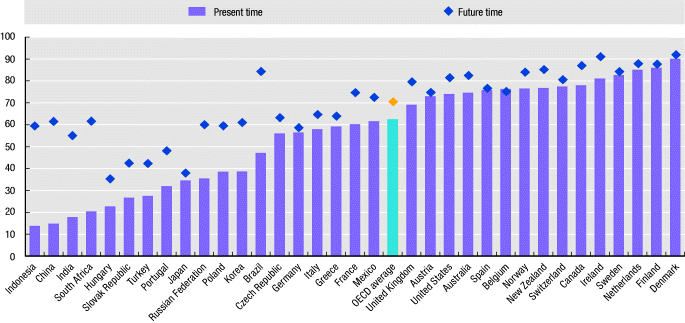
OECD Quality of Life Ranking: % of respondents reporting high positive evaluation of their lives, in present and future. (Click on graph to get into OECD, then click on graph again to enlarge.)
Among residents of the BRIC nations, Brazilians are the happiest, followed by Russians, whereas the Chinese are the least happy, followed by the Indians, according to a recent OECD report.
The OECD released its 2009 Factbook with charts and tables of economic and social indicators for its 30 members, countries “committed to democracy and the market economy,” as well as other countries, many of them applying for membership. In it, the organization ranks countries based on the relative “happiness” of their citizens.
The OECD used data from a Gallup World Poll conducted in 140 countries around the world last year, that asked respondents whether they had experienced six different forms of positive or negative feelings within the last day (per a Forbes article). Sample questions included: Did you enjoy something you did yesterday? Were you proud of something you did yesterday? Did you learn something yesterday? Were you treated with respect yesterday? In each country, a representative sample of no more than 1,000 people, age 15 or older, were surveyed. The poll was scored numerically on a scale of 1-100. The average score was 62.4. The assessment was about happiness in the present and future.
Top ten OECD members in terms of life satisfaction were dominated by northern European countries:
Denmark
Finland
Netherlands
Sweden
Ireland
Canada
Swizterland
New Zealand
Norway
Belgium
High per capita income, low unemployment, a social safety net, a relatively short workweek, and democracy appear to be key determinants of happiness. Yet culture could play a role as well, as does good family and community life. One interesting aspect of the study was the divergence of present and future happiness perceptions in some cases (see chart), which could be a measure of a people’s optimism. Brazilians appear to be an optimistic lot, with one of the highest evaluations of their future wellbeing among the 34 countries in the OECD report.