

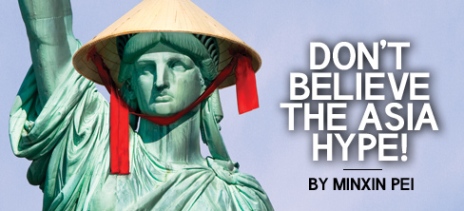

Is the global balance of power shifting from West to East? Minxin Pei, senior associate at the Carnegie Endowment for International Peace, argues in the latest issue of Foreign Policy that the hype about America’s decline and Asia’s rise is premature. Think Again: Asia’s Rise challenges the basic assumptions made about Asia’s emergence as a predominate world power. “At most, Asia’s rise will lead to the arrival of a multi-polar world, not another unipolar one,” writes Minxin Pei. Demographics, pollution, export-dependent economies and political instability are only some of the factors that could curtail the region’s rise.
“Even at current torrid rates of growth, it will take the average Asian 77 years to reach the income of the average American. The Chinese need 47 years. For Indians, the figure is 123 years. And Asia’s combined military budget won’t equal that of the United States for 72 years.
“In any case, it is meaningless to talk about Asia as a single entity of power, now or in the future. Far more likely is that the fast ascent of one regional player will be greeted with alarm by its closest neighbors…If Asia is becoming the world’s center of geopolitical gravity, it’s a murky middle indeed.”
For an alternative view, read Kishore Mahbubani’s books and articles on the dawn of a new world order and new Asian century. He is the dean of the Lee Kuan Yew School of Public Policy at the National University of Singapore.
Image from Foreign Policy.