


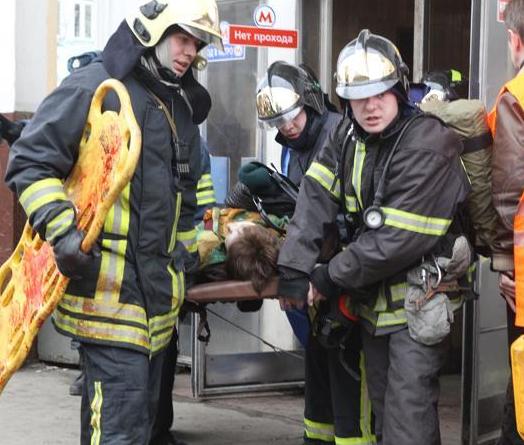

Terrorism never happens in a vacuum, yet questions of motive remain largely taboo.
We know that the female suicide bombers that killed at least 38 (hopefully this number will keep) innocent Moscow commuters came from the restive Caucasus region.
We know that Medvedev and Putin, backed by Obama, have vowed to exact uncompromising revenge.
But why did two women decide to kill themselves and scores of innocent commuters specifically at Lyubyanka station, below the headquarters of the state security services?
RUSSIA’S OWN ‘WAR ON TERROR’
America’s War on Terror has framed Islamic terrorists as irrational actors driven not by any ‘real’ grievances but rather by blind ideology, religious zealotry or envy (‘they hate us for our freedoms’).
Therefore, the argument goes, they cannot be reasoned with and must only be fought. (A Russian version of this argument was articulated today by a BBC listener from St Petersburg: “We should deal with the reason, not the consequences. And the reason is the North Caucasus, wild and unknown, which lives by its own laws”).
At the same time, any intellectuals who publicly questioned either the structural factors behind Islamic terrorism (global inequalities, poverty); or its connections to Western foreign policy (wars in Iraq&Afghanistan, human rights abuses in Guantanamo and elsewhere, support for Israel, alliances with repressive Arab regimes, etc) remain intimidated and even branded traitors.
It’s the same in Russia. The Caucasus is its Middle East, its War on Terror, with all the ensuing crimes and consequences.
In the wake of September 11th, Putin cleverly re-branded his brutal irredentist anti-secessionist war against Chechnya as a sub-heading in George Bush’s War on Terror.
Thus, a fluid coalition of rebel groups with complex nationalist, religious and cultural demands became subsumed into the category of ‘Islamic fundamentalists’, ‘Wahhabists mercenaries’ and ‘international terrorists’: in short, they were no longer to be negotiated with.
‘Why Do They Hate Us ‘?
Let’s be clear: there are no good guys (or at least, no good guys left alive) in the sordid tale of Russia and the Caucusus.
Johar Dudayev and, to some degree, Aslan Maskhadov – the last secular nationalist leaders in Chechnya- have long been killed, and with them the last hope of a reasonable settlement of the conflict. Dudayev was cowardly blown up by a missile as a result of a particularly nasty double-cross by Yeltsin; Maskhadov was taken out by FSB agents a month into a cease-fire.
Today, Chechnya is controlled like a personal fiefdom by Putin’s (barely) loyal (for now) warlord Ramzan Kadyrov, an (allegedly) tiger-wrestling, supercar-collecting playboy. His iron grip, coupled with billions of dollars of Kremlin largesse, have kept a lid on the insurgency, which has spread to the neighbouring republics of Ingushetia, Dagestan and Northern Ossetia.
There are no heroes on the rebel side either. Organised criminals, local warlords and al-Qaeda mercenaries are behind at least some of the violence.

In fact, Galina Yemelianova, a lecturer in Russian and East European Studies at Birmingham University, says suicide is against Caucasian tradition but its use shows jihadist influence on North Caususus insurgent groups.
In sum, the insurgency has lost the righteous, secular fervour of the early 1990s. These days, it’s (mostly) all about the money; in fact, the recent attempted assassination of Russia’s man Yevkurov in Ingushetia was blamed on his anti-corruption drive.
Yet on balance, it is Russia’s policies in the region (NOT Russian civilians) that must bear the brunt of the blame for fostering extremism and terrorism.
1. HUMAN RIGHTS ABUSES
Thousands of people, mostly young men, routinely disappear. They are tortured and killed by Russian security forces, though it has not been established whether these actions have been officially sanctioned or the work of freelance soldiers.
The novelist Jonathan Littell has written about the parallels between Chechnya today and Stalin’s purges:
‘Chechnya is like 1937, 1938,’ Aleksandr Cherkasov, one of the leaders of Memorial, the largest Russian human rights association, asserts in his little Moscow office. ‘They’re completing a vast construction programme, people are getting housing, there are parks where children play, theatres, concerts, everything seems normal … and at night, people disappear.’ One hears this comparison often from Russian human rights defenders, and as Cherkasov points out, it’s not as far-fetched as it seems: the number of people killed or missing in Chechnya, over a ten-year period, is, according to him, proportionally greater than the number of victims of Stalin’s Purges.
‘Torture is an integrated part of the legal system in Chechnya”, according to Cambridge University’s Mantas Kvedaravicius, who has done research on torture in Chechnya from an anthropological and philosophical point of view.
Usam Baisayev, of Russia’s respected human rights organisation Memorial states:
The human rights situation in Chechnya has in the last two years gotten worse. In 2009, 90 people where reported kidnapped. Out of these, 10 has been found killed, 18 has disappeared and the last 58 has been tortured and then released. Only four of these people has been further investigated, and are considered criminals. Since the anti-terror operation officially ended in April 2009, 292 person have been killed. The situation for human rights in Chechnya is still very grave, and unfortunately, it is getting worse.
Yet the crazy truth behind all this is that these human rights abuses contribute to terrorism in ways much more prosaic than ‘Islamic radicalisation‘.
As the BBC’s Dom Rotheroe has reported, when local authorities randomly round up young men to fulfil quotas and show that they are fighting the militants, their angry relatives join rebel groups:
“Some may do so out of religious belief, yet Magomed Mutsolgov of human rights NGO, Mashr, believes that at least 80% leave home because of revenge…In a society in which blood vendettas are part of a man’s honour, young male relatives of the deceased have to seek their own justice. They head into the hills to get a gun and take revenge. And while with the extremists, their ideology may shift accordingly”.
In fact, today’s blasts have been attributed to the Black Widows, an outfit of female suicide bombers motivated by revenge for the deaths of their male relatives.
Indeed, Sean at Sean’s Russia Blog has confirmed that ‘experts believe that the bombs are in response to the recent killings of Chechen militant leader Anzor Astemirov, the so-called “Emir of Grozny” Salambek Akhmadov, Abu Khaled and Said Buryatskii. Former FSB director Nikolai Kovalev says that the female suicide bombers could have been relatives of Buryastskii”.
Talk about cause and effect.
2. POVERTY
Last year, President Medvedev himself admitted that extremism’s roots ‘are in the living conditions, in unemployment, poverty’.
A 2005 report found that ‘more than 90 percent of the population in war-torn Chechnya are living below the poverty line’.
Yet little has changed; Russia’s southern republics remain riddled with unemployment, poverty, corruption and crime: the perfect environment for desperate and vulnerable young people to turn to terrorism.
Compare that with Soviet times, when Chechnya and the caucasus were some of the wealthiest parts of the USSR and secessionist tendencies lay mostly dormant.
3. RUSSIAN RACISM
Itself an outgrowth of poverty, one of the darkest features of post-Communism has been a huge surge of racist sentiment and violence in Russia. Blacks, central Asian guest workers and anyone with dark skin are frequently subject to brutal assaults in person as well as on internet message boards.
Much of this violence has its roots in the economic collapse of the 1990s, when guest workers and immigrants were seen as competitors for very scarce resources. It became even greater after the Chechen war, when successive governments encouraged or ignored the jingoist rhetoric of the far right.
Terrorist attacks always trigger surges of racist violence, which are then used as recruiting tools by separatists looking to demonise Russians.
As one frightened woman emailed to the BBC: ‘I myself look Mediterranean, and am now not only scared of terrorists but also of my co-citizens’.
WHAT IS TO BE DONE?
The fact that 9-11, Beslan and the other bloody terrorist atrocities claimed so many Russian and American civilian lives makes it very difficult to talk about motives without being seen to justify such violence or appear callous.
Yet it is arguably precisely such refusal to confront the motivations of terrorists and the provocative role of Western policy itself that confounds and deepens the terrorist threat: removing any prospect of dialogue, diplomacy and settlement can leave violence as the only alternative.
Sadly, that is precisely what is likely to occur.
As with each large terrorist attack in the past, the government’s grip on the country is likely to increase, civil liberties are likely to suffer.
Shortly after Beslan, for example, Putin cancelled direct elections for governors.
This time, the BBC Russian Service’s Andrei Ostalski says ‘the attacks could lead to ‘those who actually favour tightening up the screws in Russia again to push ahead with this”. He adds that Vladmir Putin’s response could improve his chances of taking back the presidency in 2012’.
Unfortunately, in addition to the 38 dead, today’s terrorist attacks will continue to do damage – to Russian democracy, the the civility of its society, to peace in the north Caucasus and its human rights situation – for some time.
But Russia is a tough, resilient place, and it will recover.
In the words of Russia analyst ‘A Good Treaty’ posted on Sean’s Russia Blog, ‘a friend in Moscow tells me that people are in shock, but that the city has far from shut down. Russians are some tough mofos’.
Amen to that.