


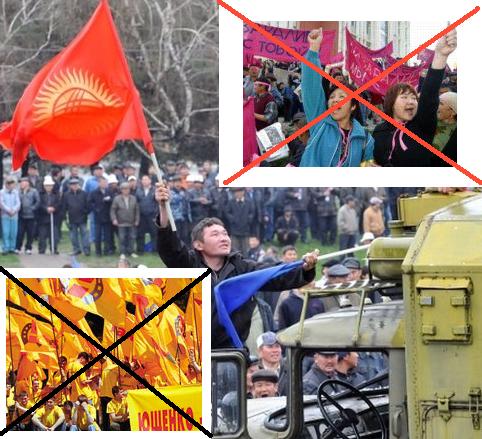

And then there was one.
Seven years after Saakashvili ushered the first of three coloured revolutions in post-Soviet Europe, February’s Ukrainian elections and now the Kyrgyz overthrow of the Tulip revolution have left him the last man (precariously) standing.
While it is still unclear what the final outcome will be in Kyrgyzstan (although the opposition leader Roza Otunbaeva has declared victory and Bakiyev himself admitted that “I don’t have any real levers of power”, he remains defiantly clinging to the presidency from an undisclosed location in the south), the self-appointed opposition is likely to bring the country closer to Russia .
If that happens, then it will follow on the heels of Ukraine, whose newly elected president Yanukovich is set on reversing some of the policies enacted by the Orange revolution and recalibrating its relationship with its northern neighbour to a friendlier footing.
The convenience of these two events has led to questions of whether Russia may have played a hand in engineering Bakiyev’s ouster.
Putin has emphatically denied this, but, according to Sean‘s quote of David Trilling, he was certainly angry at his u-turn over the American Manas base and has been punishing the country with added duties on energy, which could not have helped the embattled president. On top of that, Russia was the first country to recognise the new regime, Medvedev’s conversation with Otunbayeva carrying uneasy echoes of Putin’s ill-fated, premature congratulations to Yanukovich in 2004 – exactly what Russia had so studiously avoided doing the second time around.
So is post-Soviet Europe inching towards a pre-2003 status quo, a post coloured revolution Thermidor?
That is unlikely. For a start, the coloured revolutions were never a rejection of the countries’ international policies or their geopolitical orientations. In fact, most Georgians and Ukrainians continued to oppose Nato entry and favour close ties with Russia.
The revolutions were a rejection of the corrupt political cultures, authoritarianism and dire economic performances of Kuchma, Schevarnadze and Akayev.
And they were eventually brought down for the same reasons: the incompetence of Yuschenko, the corruption of Timoshenko and the incompetence, corruption and authoritarianism of Bakiyev.
When people threw out the Orange and Tulip revolutions, just as when they had originally brought them in, they weren’t doing it to bring their countries towards Russia or away from America.
To inject some cheap faux-Hegelianism into the equation: think of pre-2003/2005 as Thesis, and the coloured revolutions as the Antithesis.
By that logic, the current events will not so much undo the coloured revolutions as offer a Synthesis – a cautious and pragmatic mixture of the pre-revolutionary (less radicalism, less hype) and the revolutionary (more demands for democracy, transparency and economic performance).
Let’s hope it succeeds. But, as Otunbayeva herself had once stated, “Once the people get the taste of toppling presidents by getting on to streets, it will be difficult to change governments any other way”.