

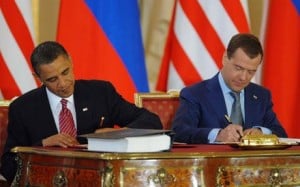

Russia and the U.S. signed the new START Treaty today in Prague. It was the kind of international event that would have garnered major press coverage in times past, but no longer. If you were busy today, you may have missed the news. It has been some time since the world lived with the fear of nuclear annihilation and as those fears subsided so has the amount of attention devoted to such issues. Part of me resents this a bit, after all, nuclear weapons are a big deal, we should all be paying attention to efforts to reduce or eliminate them. Still, I understand the basic reality that no one expects a nuclear exchange between the U.S. and Russia anymore, so this ranks low on our collective radar. I wonder if the diminished appreciation for the importance of these kinds of treaties in our contemporary culture is a reflection of the fact that we subconsciously know that both the U.S. and Russia are reducing from their surplus and not making the kinds of cuts that would undermine deterrence or even come close to eliminating nuclear weapons altogether? This report in The New York Times makes this point clear:
The treaty, if ratified by lawmakers in both countries, would require each country to deploy no more than 1,550 strategic warheads, down from 2,200 allowed in the Treaty of Moscow signed by President George W. Bush in 2002. Each would be limited to 800 total land-, air- and sea-based launchers — 700 of which can be deployed at any given time — down from 1,600 permitted under the Strategic Arms Reduction Treaty of 1991, or Start. Because of counting rules and unilateral reductions over the years, neither country would have to actually eliminate large numbers of weapons to meet the new limits. Moreover, the treaty does not apply to whole categories of weapons, including thousands of strategic warheads held in reserve and tactical warheads, some of which are still stationed in Europe.
So, to summarize, we are keeping the nuclear triad of land, sea and air based launch systems, and reducing the number that can be deployed at one time while also drawing down the total number of missiles that are available for launch on those systems by about a third. The treaty is not addressing reserves and tactical nuclear weapons at all, which is a rather large exemption. Both countries will still have enough missiles and launch/delivery systems to “do the job” (in the old MAD sense) several times over.
I can’t quite shake the feeling that this treaty, though an important step, is really just political theater. It’s real value is the demonstration effect, it’s showing countries in the nuclear club, and the countries that want to join the nuclear club, that Russia and the U.S. are capable of reducing the size of their nuclear arsenals as they work to halt the spread of nuclear weapons. Is it a coincidence that an international conference on that subject convenes in Washington next week?
If you are interested in more in-depth analysis of this new arms treaty, I recommend the following two interviews from the Carnegie Endowment for International Peace. In this first interview, Matthew Rojansky examines the treaty from a U.S. perspective, and then in the second interview, Alexei Arbatov gives the Russian perspective. You will find the full text of the treaty here, as well as the implementation protocol here.
Finally, for those of you who process information visually (thank you for reading to this point), here is a report from MSNBC on the treaty signing and related issues:
Visit msnbc.com for breaking news, world news, and news about the economy
Photo Credit: AFP/Getty Images