


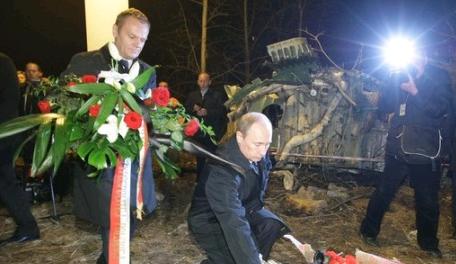
When it comes to Russia, Anne Applebaum suspects the worst at the best of times. She saw the nefarious hand of the Kremlin even behind her recent car breakdown. So if Applebaum, whose Polish foreign minister husband could easily have also been on that doomed plane, is lauding the way Russia has handled the aftermath of the tragedy, that’s big news.
“The open discussion of a tragedy represents a revolutionary change”, she writes, noting that “Russian officials are showing more transparency in the wake of this tragedy than they have shown after some of their own”.
In my last post, I worried that Russia might do the wrong thing and revert to its usual secrecy and brusqueness, which is what Putin had done in the wake of the Kurk disaster with his refusal to even cut short his holiday, and the Politkovskaya murder, with his diffident remark that “she did not have a serious influence on the political mood in our country”.
But this time he acted entirely differently, taking charge, opening up the investigation fully, declaring a day of naitonal mourning, and going so far as to hug Prime Minister Donald Tusk. It wasn’t just good politics: ordinary Russian people were deeply and genuinely saddened by the tragedy.
The sympathy was well received by Polish people and elites.
“Russia-Poland thaw grows from tragedy”, adds the BBC.
“It’s a paradox but the tragedy in Smolensk is a chance to connect our nations like never before,” Marcin Wojciechowski wrote in a column in the leading daily, Gazeta Wyborzca.

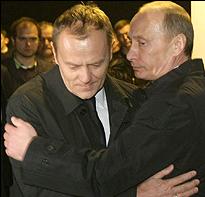
“Russia’s behaviour after the tragedy in Smolensk totally contradicts the thesis of those who claim that closer relations between Russia and Poland are impossible,” he said.
‘It is something of a paradox’, the article continues, ‘that this latest tragedy to befall the Polish nation may actually prove to help the process of reconciliation between the two nations’.
But it is not only Russia which rose to the occassion and above pettiness. Poland must be equally praised, especially when it could have easily turned the tragedy into an opportunity to whip up anti-Russian sentiment and conspiracies.
Russia’s behaviour is reminiscent of its outreach to the US after the September 11th attacks, when Putin, in the words of the US government, “seized upon the tragedies of the World Trade Center and Pentagon as an opportunity to transform relations with the U.S. from distant and sometimes hostile to one of broad cooperation and new opportunities in many fields”.
Yet Poland’s magnanimous response is very different how the US responded to Russia’s unprecedented overture: by unilaterally withdrawing from the ABM treaty. As Stephen Cohen writes, after 9/11,
Putin’s Kremlin did more than any NATO government to assist the US war effort in Afghanistan, giving it valuable intelligence, a Moscow-trained Afghan combat force and easy access to crucial air bases in former Soviet Central Asia.
The Kremlin understandably believed that in return Washington would give it an equitable relationship. Instead, it got US withdrawal from the ABM treaty, Washington’s claim to permanent bases in Central Asia (as well as Georgia) and independent access to Caspian oil and gas, a second round of NATO expansion taking in several former Soviet republics and bloc members, and a still-growing indictment of its domestic and foreign conduct. Astonishingly, not even September 11 was enough to end Washington’s winner-take-all principles.
The Katyn crash could have plunged Russian-Polish relations into darkness; happily, cooler heads – both in Moscow and Warsaw – have so far prevailed.