


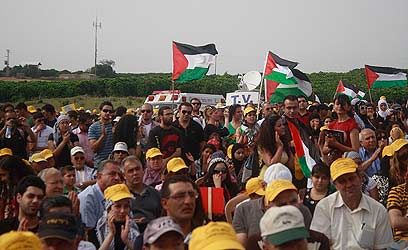

Israelis celebrated Independence Day this week, rejoicing in the streets, on the beach, at barbecues, and dancing to music at concerts throughout the country. While Israelis rejoice, some in society are not quite as happy, namely Arabs and Palestinians who label Israeli independence as the “Nakba,” which is translated as “the Catastrophe.”
Protesters “mourning” the Nakba carried Palestinian flags, as expected, but they also paraded around with Turkish flags, which is particularly interesting due to the increased tensions between Israel and Turkey stemming from Operation Cast Lead.
Commemorating the Nakba has been a source of significant tension within Israel and has been used as indicative of perceived Palestinian and Arab sentiments regarding the Jewish state. While many Israelis have supported a two-state solution, critics of the Nakba celebrations point to them as proving that Palestinians mourn Jews coming to the region and actually oppose a two state solution.
This interpretation of Nakba events certainly has some merit. Some of the Palestinians commemorating the Nakba oppose a two state solution and would prefer that Israel never emerged. However, other mourners of the Nakba use Israeli Independence Day as a symbol of disparities between Israeli and Palestinian societies.
While Israel has one of the world’s leading economies and high-tech industries, Palestinian society has not thrived economically. Granted, the root cause of this disparity is under significant debate. Some Israelis content that Palestinian corrpution has squandered opportunities to develop institutions and a viable economy, with Palestinians more concerned about attacking Israel then improving their own lives. On the other hand, some Palestinians point to the lack of freedom of movement in the West Bank and the virtual embargo on the Gaza Strip as merely fueling the disparity and undermining Palestinian efforts to create a viable economy.