


Andrey Voznesensky, the Russian-Soviet poet who died yesterday, spent his life in a no-man’s land between poetry and politics, ‘left’ and ‘right’, East and West.
Along with Bulat Okudzhava, Bella Akhmadulina and Yevgeny Yevtushenko, he formed the core of the Soviet ‘beat poets’ of the post-Stalin thaw.
And unlike the likes of Joseph Brodksy and Solzhenitsin on the one hand and Sergei Mikhalkov on the other, Voznesensky also uneasily straddled the Iron Curtain without either immigrating or being co-opted.
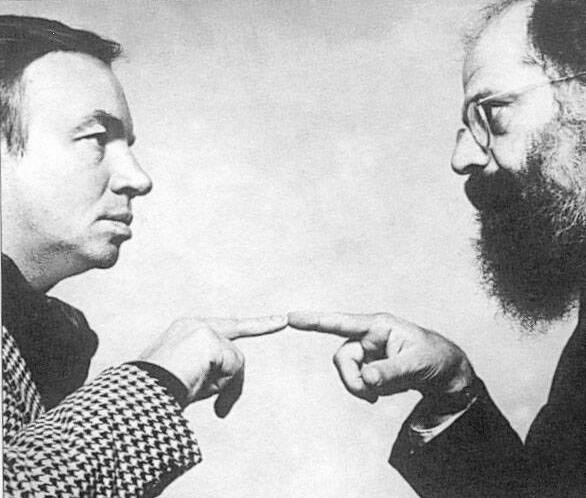
He read his poetry in America and all over Western Europe, and his friendship with Allen Ginsberg showed the universality and internationalism of the 1960s spirit. Voznesensky’s opposition to the Soviet invasion of Czechoslovakia mirrored his counterparts’ opposition to the US invasion of Vietnam; his
Yet this very internationalism raised a key issues about the role of ‘moral equivalence’, loyalty, and politics in art.
For example, John Updike rebuked Robert Lowell (and, implicitly, many liberals/leftists in the West) for drawing a comparison between the Voznesensky’s Soviet government and the US:
We worry that our side will do him in. Introducing him at a poetry reading last May, Robert Lowell confided to the audience that that he thought both he and Voznesensky had “really terrible governments.” Such a remark could not hurt Lowell but would certainly arrest the attention of the Russian Embassy watchdog who invariably attends displays of Russo-American cultural exchange.
Да здравствуют Антимиры!
Фантасты - посреди муры.
Без глупых не было бы умных,
оазисов - без Каракумов.

Long live the Antiworlds
Fantasists amidst the muck.
Without the stupid there would be no smart,
no oases without deserts.
Yet perhaps poets need something to push against. As Dwight Garner notes in today’s New York Times,
Russian poetry in 2010 has lost most of the awful things it once had to push and grind against — happily for its poets, perhaps, and perversely less happily for its verse.
And if it was once disingenuous to compare the stifling of art in the West and the USSR, then, “since the collapse of the Soviet empire in 1991, Russian poetry has begun to resemble American poetry in ways that are both fascinating and sad,”, he writes.
“What’s fascinating is how talented, and how different from one another, ’s young poets are. What’s sad is how little they are read, and how little they matter”.
The antiworlds Voznesensky created with his poetry gave acknowledgment and inspiration to a generation of young people coming of age after Stalin; giving life and permanence to the Thaw; creating a bridge between once insular Soviet culture and the West.
But even more importantly, Voznesensky was an ambassador for poetry itself, filling stadiums with his electric readings not just in Russia, where poetry remained a potent force (not just because it could get you arrested), but also in the US and around the world.