

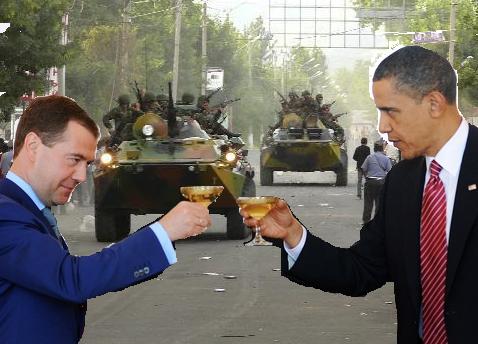

Amidst all the horrific ethnic violence in Kyrgyzstan, there may have been one welcome victim: the zero sum, Cold War style thinking that had governed Russia and America’s approach to the region.
For a few nervous days this week, however, the conflict felt as if it could unleash a major regional and even international war.
According to a creative if somewhat over the top scenario from Stratfor’s Peter Zeihan, Uzbekistan might attack Kyrgyzstan to defend that country’s beleaguered ethnic Uzbeks. That would lead Kyrgyzstan’s ally Russia into war with Uzbekistan, and might even end up dragging it’s ally the US into WWIII.
On firmer but similarly pessimistic ground, Radio Liberty’s Brian Whitmore felt that entering the conflict might be Russia’s only way of enforcing its regional credibility. He writes:
For Russia this is a very serious test,” says Fyodor Lukyanov, editor in chief of the Moscow-based journal “Russia in Global Affairs. “We wanted responsibility and influence. OK. So let’s go.”
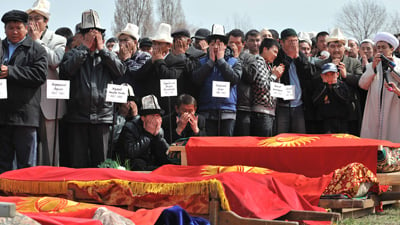

This view is echoed by Igor Turbakov in Russia Profile:
Russia is faced with a painful policy dilemma. As Russia has long been casting itself as the main provider of security in the post-Soviet space, the Kyrgyz crisis appears to represent a moment of truth of sorts when Moscow has to deliver. All the more so since the hapless leadership in Bishkek openly acknowledged that it had lost control over the situation and directly appealed to Russia for aid, asking for peacekeeping troops to be urgently sent in.
If Russia doesn’t step up to the plate, referring, as it recently did, to the crisis as an “internal conflict,” it risks losing face, prestige and the right to claim the leading role in the post-Soviet Eurasia.
So it increasingly looks like a damned if you do, damned if you don’t scenario for Russia, which will look weak if it doesn’t act but would be stuck with a long and messy, unwinnable war if it does.
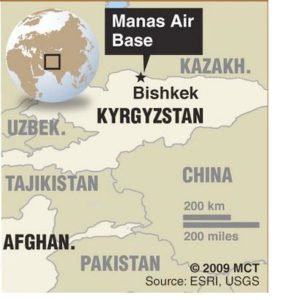

For a start, Russia refreshingly declined a cheap and very tangible strategic gain from sending troops to Kyrgyzstan: the removal of the troublesome US base that the Kyrgyz president Otunbaeva offered in exchange for intervention.
The gesture not only established trust with rival America but also showed that Russia may be stepping away from its policy of force (as in Georgia, Chechnya) and exploiting (or generating) instability in the near abroad for the sake of reconstructing its formerly exclusive sphere of influence.
The US, too, appears to also have left behind its former readiness to both exploit Russian weakness and/or restrain (eg by expanding Nato eastwards in the 90s) and fail to reciprocate acts of goodwill (eg by betraying Russia in the wake of its post 9-11 cooperation).
The US have cooperated closely with Russia this week, and the two countries recognise that they share common aims: the US needs Kyrgyzstan
Because of this, according to the Washington Post’s David Ignatius, the conflict “is offering a new opportunity for Moscow and Washington to work as partners”.
Perhaps a little too optimistically, he believes that:
Substituting cooperation for Great Gamesmanship in Central Asia is a welcome change from a few years ago. Now if this model of Russian-American collaboration could just be expanded to deal firmly with Iran, we might have the beginnings of a system that deserved to be called “collective security.”
So which is it?
Are we seeing the emperor being exposed, with Kyrgyzstan calling Russia’s bluff over its claims to control the region, and about to either concede defeat or enter into a bloody folly?
Or the dawn of a new era of mutually supportive, complementary and cooperative relationships between Russia and the US acting as joint caretakers and safe pair of hands in a rapidly Islamicising part of the world?
It might sound like the biggest of copouts, but the answer is: a bit of both.
Let’s be clear: neither Russia nor America are changing their stripes. Just as Russia played a hand in the overthrow of Bakiev, the US have been instrumental in propping him up (and perhaps even some US money was used to start the violence). On the other hand, James Kirchik claims that Russia is using this conflict to stamp out the shoots of democracy.
But just as it is not in the US interest to see the collapse of Russia as the regional hegemon, it is not in Russia’s interest to see the US, with its anti-terrorist and anti-jihadi capabilities, abandon the country’s sensitive southern flank.
They may not have become friends, but the US and Russia seem to have recognised that neither is powerful enough to go it alone: the US needs Russia’s help with Afghanistan, and Russia needs the US’s help in keeping Islamic radicalism at bay.
The good news is that both countries have had to resist a lot of pride and populist pressure to regionally prevail or exploit the others’ weak position, which would have been an easy and tempting short term PR but disastrous in the long run.
Unfortunately, such poor decisions have been taken so many times in the past by both powers in the past: one reason why a normal and rational stance in this case seems so special.