

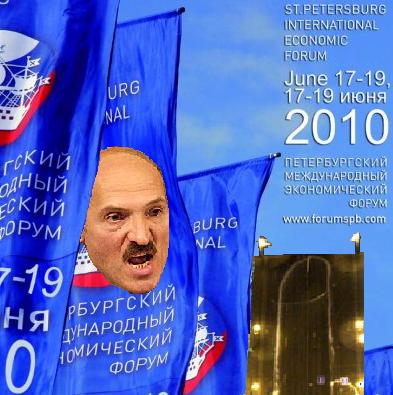

Last weekend’s St Petersburg International Economic Forum, meant to showcase Russia’s transition from authoritarian raw materials exporter to pluralistic hub of technology and commerce, hit two snags: an embarrassing gas dispute with Belarus, and a giant penis.
If the former demonstrated the limits of Russia’s pledge to move away from energy-centric bully tactics, the latter – a giant phallus, covertly painted on the tarmac of St Petersburg’s iconic Liteiny Bridge by the art action group “Voina”, or “War”, that towered over the city and the nearby FSB offices once the bridge was drawn – tested the boundaries of Medvedev’s stated commitment to openness.
Medvedev did a good job of convincing investors that Russia was breaking off its dependence on natural resources to focus instead on entrepreneurship and innovation. “We’ve changed,” the president stressed – and investors seemed to buy it.
But is all the talk of a new Russia simply a red herring, an empty re-branding exercise?
That’s because the current desire to diversity Russia’s economy is grounded in a stark economic imperative:
Bankers say the transformation rhetoric is being ramped up because Russia was humbled by the huge fall in national output – a contraction of 7.9 per cent in real gross domestic product last year alone – it suffered as commodity prices plummeted in 2008 and all but erased the paper fortunes of the country’s billionaires.
Clover, Gardner and Belton posit another reason why siloviki such as Sechin are changing their tune: they might be trying to align themselves closer to Medvedev’s more liberal agenda in case he proves more resilient than previously expected:
“They are beginning to get nervous,” one insider says. “There is no decision on what is going to happen in 2012. They don’t know what their future would be under a Medvedev second term.”
I’m not sure that the changes being talked about have much to do with Medvedev’s ostensibly personal liberal temperament, or whether it even matters, because the economic restructuring is an imperative of survival on which Medvedev’s career rests as much as Sechin & co’s.
On the other hand, as China’s example shows, it is far from clear how economic diversification affects democratisation itself.
And that’s why it’s necessary to restrain from seeing the penis protest as a sign of cracks in the Putinite socio-political fabric, or from expecting economic reforms to necessarily engender a more empowered civil society.
In fact, a pro-Putin youth group has already praised the penis artist Leonid Nikolaev, trying to frame the action and the small fine he received as evidence of Russia’s freedom of expression.