


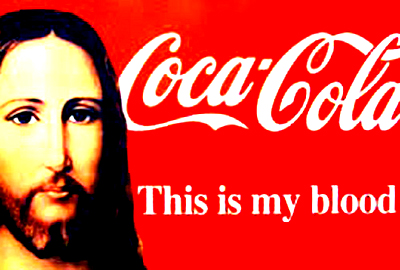

Those Bolshevik posters depicting the Russian Orthodox Church as an integral pillar of dictatorship had to wait almost a century for vindication.
For much of the post-war period, the Russian Orthodox Church was seen as a subversive repository of anti-Soviet, and by extension, liberal values. It was the declared source of spiritual inspiration for iconic Russian artists such as Akhmatova, Gumelev, Tsvetaeva and Solzhenitsin.
In fact, in the 1970s, even many Jewish intellectuals, who had only recently been the victims of Orthodox Church sponsored pogroms, stated to associate themselves with the Church as both the only available source of civil society and a locus of principled opposition to the Communist regime.
During Perestroika, the church struck a political deal of mutual assistance with Yeltsin ad the Democrats. When Yeltsin came to power, the Church was generously rewarded for its support: not only with a defacto religious monopoly (the new regime made life as difficult as possible for foreign missionaries and Muslims) but also, incongruously, with lucrative business assets including the exclusive rights to tobacco sales.


It reached such a point that during every local election, each candidate would fund the construction of a small church so that cities became dotted with the functioning churches paid for by the winner as well as the semi-constructed, derelict shells of churches left unfinished by the loser.
Today even if the current government would like the church to cede some of its power, that is unlikely to happen voluntarily: a decade worth of sponsorship, kickbacks and other largesse has created a monster that can no longer be undone similarly to what happened with the Taliban following US Cold War era support.
What is interesting is the role of the liberal opposition, headed by Boris Nemtsov, in all this.
Nemstov, it turns out, is financially supporting the defendants in the blasphemy case against the Church. Yet, in the 1990s when he was Yeltsin’s protege, he fully supported and profited from the cosy Church-state relationship that he now so heroically condemns.
So what happened? Actually, nothing. Neither the church nor the Nemtsov led liberals have changed. The Church has remained an authoritarian, illiberal and intolerant institution from pre-revolutionary times till the present. It was only supported by dissidents and democrats during Soviet times because of its anti-Communism, which was erroneously conflated with liberalism.
Similarly, Nemtsov and the entire crop of 90s liberals have always been right-wing elitists concerned only with getting and maintaining power. Cozying up to the church in the 90s was as consistent with those goals then as attacking it is now.