

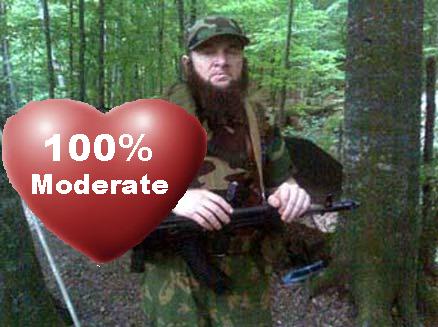

Totally moderate! That’s what Akhmed Zakayev, another former rebel leader now living in London, says.
And naturally, that’s what’s been obediently parroted by the English language press (the Russian press has been (UN)surprisingly silent on the matter, believe it or not!).
Zakayev said the new leadership wanted to focus on the possibility of talks with Moscow but did not elaborate. He added: “The only thing that we don’t accept … is violence against civilians. (We have always) condemned acts of terror.”
Radio Liberty also reported that “Zakaev described Vadalov as a moderate with no links to Islamic groups” without any attempts to fact check such an assertion.
They would have done well to read NYU Prof Mark Galeotti’s extensive backgrounder on the new chief.
Vadalov’s rhetoric…followed the Islamist trend, and by 2007 he spoke not of Chechen independence so much of a wider struggle against Russia and the non-Islamic world
Overall, the only really moderate thing about Vadalov appears to be the level of his success as a field commander; he quickly became out of his depth in charge of larger assignments. Yet Galeotti believes that Umarov, having grown increasingly unpopular among his rank and file Jihadist fighters, needed a
successor who satisfied the younger-, middle-ranking and non-Chechen commanders but who also respected him and would be unlikely to turn on his predecessor. After all, Vadalov was one of the first field commanders to pledge allegiance to Umarov when he assumed command.
The account suggests that contrary to Zakayev’s version, Vadalov represents a strategic and ideological continuity with Umarov’s policies but with a fresh face, similar to the way Putin had succeeded Yeltsin in 1999.
So why would someone like Zakayev, a cultured man of some principle who truly opposed Umarov’s brutal Wahhabism (so much that he resigned from the government in exile) now be so intent on boostering his protege?
Zakayev could simply be using the foreign media to loudly suck up to Vadalov in the hope of re-entering politics and becoming relevant again after so many years of being a frozen out ‘telephone commander’ as he was branded by Umarov.
That’s totally understandable. What isn’t understandable is just how easily Reuters and RFE/RL allowed themselves to be spun by -let’s not forget- a politician.