


President Barack Obama’s approval ratings continue to plummet and speculation swirls as to whether the 2012 GOP candidate has a near guaranteed ascent to the Oval Office. The economy is unlikely to substantially improve, the Democrats are expected to lose substantial seats in the upcoming congressional races and Obama may not be able convince voters to stick with his leadership if unemployment continues to hover around ten percent.
Granted, Obama’s mid-term approval ratings are higher than those of both Presidents Bill Clinton and Ronald Reagan, and lower than single-termer Jimmy Carter. Therefore, there is still hope that Obama and the Democrats can lick there wounds after November and convince the American people that their leadership is right for the country.
One strategy for Obama and the Democrats is to do the impossible, and they’re attempting just that.
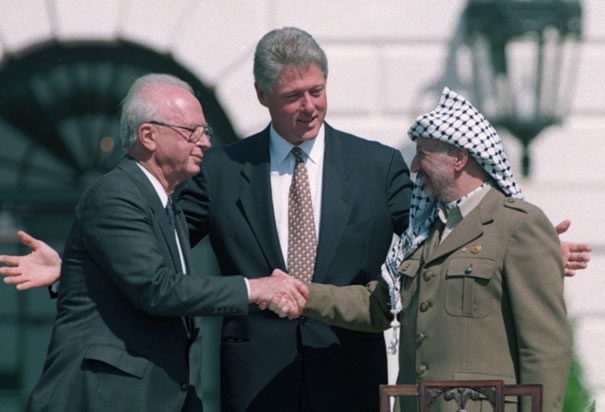
The Middle East peace plan is notorious for swelling hopes of success, before disintegrating into blame-games, terrorism and effective anarchy. President Bill Clinton, a former governor with limited foreign policy experience, boosted his international relations credentials in the end of his first term by brokering presumed eventual peace between Israeli Prime Minister Yitzak Rabin and Palestinian Liberation Organization Chairman Yasser Arafat. That image of Clinton as a foreign policy genius was encapsulated at the time in a single photograph, picturing the President in between these bitter enemies.

Then, President George W. Bush attempted his own peace summits, pitting then-Israeli Prime Minister Ehud Olmert against his Palestinian counterpart, only to watch that process quickly crumble into oblivion.
Obama’s two predecessors, not to mention previous U.S. president’s and countless international officials, staked their reputations and used their political capital on obtaining Middle East peace, but their attempts proved futile in the end.
Now, Obama dares to replicate their attempts and broker an agreement between the right wing Israeli government led by Binyamin Netanyahu and the largely powerless Palestinian Authority, with Mahmoud Abbas at the helm. Not only is Obama risking his already fragile foreign policy credentials on this process, he is setting a time limit of only one year to achieve successes that have escaped U.S. leaders for decades.
At the beginning of next month, Netanyahu, Abbas, Egyptian President Hosni Mubarak and Jordian King Abdullah will meet in Washington to begin a process that Obama hopes will result in a comprehensive and sustained peace. Obama’s envoy to the region George Mitchell has spent weeks on end shuttling between the two sides and has, until now, achieved minimal successes. In fact, at the United Nations last year Netanyahu and Abbas nearly refused to meet with Obama, although the White House averted a potential public relations disaster that could have cost the President substantial clout and credibility.
Success through the achievement of a Middle East peace would provide a shining jewel in Obama’s crown to prove — even though he was only a U.S. senator with little international experience — that he is actually a foreign policy guru that can make two arch-nemeses hug like lovers. American voters, while preoccupied about stagnant economic conditions, could stop and consider that Obama achieved the impossible, and therefore could potentially bring back jobs, lower the deficit and enhance U.S. competitiveness.
Obama’s attempts could most certainly last in a regional peace, but the more likely outcome is continued terrorism and clashes that will fuel more hate and resentment among Palestinians and Israelis alike.
However, success in the peace process could save the region and innocent lives, but it would provide Obama with an impossible accomplishment that could also save his reelection chances for a second term.