

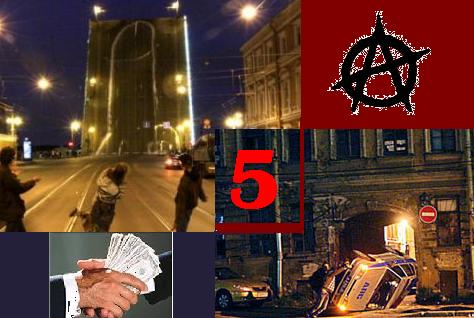

What’s the difference between spray-painting a gigantic penis on a St Petersburg drawbridge and overturning a couple of police cars?
Possibly five years in jail.
But if both were symbolic acts of petty hooliganism (recently done by the hipster anarchist group Voina, Russian for ‘War’), why did the activists get off with only a slap on the wrist for the penis, which gained international infamy, and a much more serious punishment for the overturned cop cruisers, a regular feature of youth hijinx the world over?
Because the stated reason for overturning the police cars was a protest specifically against corruption.
And while Medvedev’s Russia may have got more relaxed about shrugging off the usual maximalist anarchist provocations, it is much more touchy about the fact that corruption remains relatively unchecked throughout government agencies, business and politics. In fact, it is actually getting worse!
Even more so than democracy, human rights and press freedom, corruption is Russia’s biggest elephant in the room. No politician wants to seriously and openly pursue it because it is so endemic that the thread, if pulled, might unravel the entire political and business fabric of the country, taking all the elites down with it.
This is one reason that Medvedev chickened out of specifying exactly how Luzhkov had lost his confidence. As A Good Treaty writes,
the reason had to be vague, because any real explication would have amounted to a criticism of Moscow’s entire municipal infrastructure — a system the authorities must preserve to smoothly maintain the status quo.
And, more worryingly, it is also likely the reason behind the mysterious disappearance of “compromising materials claiming that top officials were involved in stealing over 4 billion dollars from the government budget” published by cyber-activist Alexei Navalny.
Moreover, in the wake of the Kashin affair, let’s not forget how many journalists have been beaten and killed due to exposing corruption, often petty and local, rather than political authoritarianism.
That’s because in a country where everything, especially power, is (usually dirty) money, exposing corruption may be the most serious -and dangerous- form of dissent.