


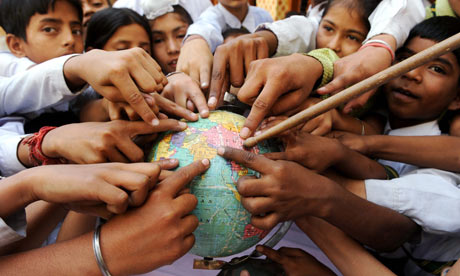


Universal Education is goal #2, Ensure that, by 2015, children everywhere, boys and girls alike, will be able to complete a full course of primary schooling, which was set under the Millennium Development Goals (MGDs) under the Millennium Declaration for 2015. While there has been significant progress made since 2000, the international community is not on track to ensure that the goal to see that quality basic education is available to all is met by 2015. In 2008, at least 67million children of primary-school age were not in school, more than half of whom were girls. If current trends continue, an estimated 57 million children will still be out of school in 2015.
Today, the United Nations Economic and Social Council convened a meeting at the UN Headquarters in New York entitled “Partnering with the philanthropic community to promote education for all.” Participants hope to accelerate progress in achieving education for all children around the world by engaging supporters from the private sector and philanthropic world to help fund and promote global education initiatives.
The key objective of the special event is to increase focus on issues central to the achievement of education for all, through:
- broadening of the range of stakeholders involved in the work of ECOSOC, as well as increasing the awareness amongst the philanthropic community on the progress made and the challenges faced in achieving the internationally agreed goals and commitments on education;
- promoting concrete initiatives by the philanthropic community and initiating new partnerships that would accelerate progress in reaching the international goals and targets related to education;
- expanding multi-stakeholder engagement in the international community’s efforts to help advance the progress on the two focus areas mentioned above.
Following the special meeting UNICEF Radio moderator Amy Costello spoke on today’s podcast with Professor Jeffrey Sachs, who moderated the closing session of the event. Hear Sachs discuss the role of philanthropy in achieving universal access of education for and about the transforming effects that technology is having in classrooms across the globe.
For more information please see the the World education blog and the following Reports:
Reaching the marginalised: Education for All global monitoring report 2010
This report, from Unesco, argues that the dynamics of education and inequality have been exacerbated in the aftermath of the global economic downturn.
Many paths to universal primary education: Time to replace the indicative framework with a real country-driven approach (12 pages, PDF)
Policy brief from The Brookings Institute which examines the effectiveness of the Education for All-Fast Track Initiative (FTI) and argues that the use of a specific global framework and its associated indicators effectively means limiting country ownership by imposing prescriptive, donor-designed solutions.
Reconceptualising access to education
Policy brief from the Consortium for Research on Educational Access, Transitions and Equity which takes a look at why access to education is important for development and providing insight how and why exclusion occurs.
Education for All – Global Monitoring Report
The 2010 Education for All Global Monitoring Report from UNESCO argues that the financial crisis could create a lost generation of children whose life chances are irreparably damaged by a failure to protect their right to education.
2009 State of the World’s Children
Unicef’s interactive report focusing on the 20-year anniversary of the Convention on the Rights of the Child includes a video outlining the keys issues, the full report and a breakdown of statistics (such as education and health).