


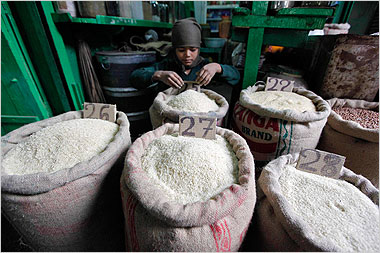

As part of its “Room for Debate” series, The New York Times convened a panel of experts to discuss the causes and possible solutions to currently high global food prices, in particular, whether the world is producing enough food. The panelists pointed out that some of the usual suspects from the 2007-2008 crisis are at fault now as well, for example: the diversion of land to grow corn for ethanol instead of food, the falling investment in agriculture, and of course, the growing appetite for meat in China and other affluent countries which is increasing demand for grains and other feed for livestock. Put together, these factors are taking away from land and resources that could be used to feed the burgeoning population.
The panelists also discussed solutions available to prevent another global food crisis. Some are calling for more liberalized trade, such as the panelist Michael Roberts, who argues that “trade restrictions remain pervasive and help to keep commodity prices high.” Roberts pointed towards recent research by Reimer and Li of Oregon State University that shows “prices could fall by 57 percent if all countries were as open to trade as the United States.” But some argue that liberalizing trade does just the opposite and is actually harmful to global food security. Egypt, where high food prices are part of the recent unrest, was once a major wheat exporter in the 1960s and was able to meet its own needs. Following World Bank and International Monetary Fund advice in the 80s and 90s, however, Egypt soon became the world’s largest wheat importer, and may have become more and more vulnerable to price hikes and price volatility.
Free trade policies can leave food security vulnerable, and David Dawe of the Food and Agricultural Organization argues that falling investment in agriculture in the past three decades “resulted in lower growth rates for cereal yields…while demand for food in developing countries continues to increase. Naturally, this leads to tighter markets and greater vulnerability to shocks.” What we need, then, is greater investment in agriculture, according to the panelists and experts. Bryce Knorr of Farm Futures Magazine has this to say:
“Feeding a growing world population with rising dietary expectations will demand ever greater production, especially if greater reserves are needed to provide security from weather disasters. Fortunately, while the planet may be running out of land, it’s not running out of potential to increase production of food and fiber. Crop yields in Ukraine, for example, are barely a third of those achieved regularly in the U.S.”
Most of the other panelists, including Michael Roberts, agree: “Productivity growth will need to accelerate from historical trends to keep up with F.A.O.’s predictions for population and income growth. If it doesn’t, prices will trend higher, perhaps a lot higher.”
Photo Credit: New York Times