

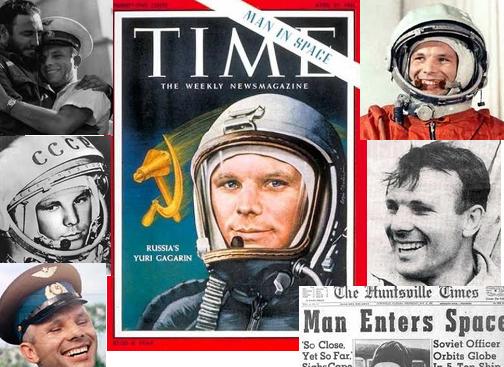
50 years ago today, a man in a gleaming white helmet and bright orange jumpsuit approached a peasant woman in a field of potatoes, and asked where he could find a phone. “Could it be that you’ve come from outer space” asked the woman, crossing herself?
“As a matter of fact, I have”, replied Yuri Gagarin.
There are many amazing things about the man who flew to space just 60 years after the Wright Brothers’ first plane. But did you know that Gagarin:
*Worried that he would not have enough sausage to last his flight
*Owes his spaceflight to a 19th century cult called Cosmism established by a mad Russian eccentric
*Was the first man to pee on the rear wheel of the bus travelling to a rocket launchpad (a tradition followed by every cosmonaut since)
*Had to duct tape his own capsule as he waited for launch, and couldn’t keep a log because he lost his pencil in zero gravity
*Loved to read Saint-Exuperry’s book about a doomed aviator
But perhaps the most amazing thing about this gregarious, open-hearted and fearless man is that, for being the ultimate poster-boy of the Soviet system, Gagarin belonged not to Russia but to an age-old international fraternity of explorers and adventurers that was impervious to cold war boundaries. Though he was a loyal communist and patriot, Gagarin won the world’s love by ignoring the artificial dividing lines of politics.
On a trip to capitalist, enemy England, he met his hero, the legendary pilot Captain Eric “Winkle” Brown, and confessed to him the then secret information that, contrary to Soviet accounts, he had bailed out of his capsule on re-entry. He did this in the confidence that Brown would not make the information public, on account of “a code of honour between fliers that transcends political boundaries”, and Brown did not.
The incident illustrates the universality of Gagarin’s achievement: he was a airman first, and a Soviet second. It reminded me of the stories my dad, a former seaman, used to tell me about his old captaining days. In the frigid depths of the Cold War, sailors of all nationalities would meet in international waters and foreign ports to drink and exchange tall tales and share practical tips and recount adventures in broken English: human bonds and experiences that few Soviets or Westerner landlubbers were exposed to, and which showed – heretically!- the world for the unified thing that it is.
It’s no wonder Gagarin’s achievement is celebrated in England, America and elsewhere apart from just Russia: at the height of the world’s ideological conflict that divided humanity into arbitrary enemy camps, he spoke the transcendental language of idealism, fearlessness and old fashioned adventure that excited and united the world as much as anything in today’s globalised, interconnected age.