

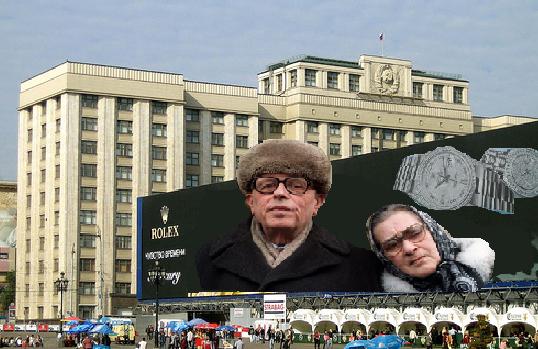
The death of Andrei Sakharov’s widow, fellow human rights activist Yelena Bonner, over the weekend brought out the usual opportunists.
In Russia, right wing liberals like Boris Nemtsov immediately swooped down to claim her mantle: “The demise of such a Soviet dissident as Yelena Bonner is a huge loss for our society, which is badly disoriented by cynicism and cruelty and where humanism and dignity are no longer valued”, said Nemtsov, who knows a thing or two about cynicism and indignity, having been one of Yeltsin’s economic architects and long-time bedfellow of Russia’s most hated man, Anatoly Chubais.
Abroad, former Tory apparatchik Edward McMillan-Scott writes in the Guardian that in honour of Bonner’s legacy in taking on the Russian elite, British PM David Cameron should “stand up to Putin”:
David Cameron is to visit Moscow soon. He should not forget that his predecessor Margaret Thatcher earned respect by speaking the truth about the Soviet Union. Europe needs leadership on Russia. Britain is one of few countries that does not depend on Russian oil and gas. Cameron can afford to speak the truth.
At least his readers appreciated McMillan-Scott’s unintentional humour:
“Dave stand up to Putin? Unlikely, he’s one of the big boys. Cameron can only bully little people.”, writes Strummered.
Vraak, quoting McMillan-Scott’s characterization of Putin’s regime as “an unaccountable and corrupt cabal” snarks: “Surprised [Cameron] kept away for this long”.
“Stand up? He’s more likely to lay down next to him on Oleg Deripaska yacht!” Chortles JimmerInManila.
Ordinary people can clearly see the hypocrisy of right wing Westerners conveniently denouncing human rights in Russia.
Bonner’s own legacy in Russia is also very mixed: she was far from a popular icon. During the Soviet period, most ordinary citizens were quite ambivalent about the dissidents.
Bonner’s combative, austere and polarizing personality did little to endear her to the masses, who were uneasy about the tightly knit circle of bohemian intellectuals – suspiciously cosmopolitan, mostly Jewish, unintelligibly cerebral, vaguely dangerous, and faintly contemptuous of the “heartlands” beyond Moscow and St Petersburg.
While their bravery and commitment cannot be faulted, by the 1970s, the dissident movement was often seen as a bit solipsistic: increasingly, it boiled down to dissidents fighting for the rights of other dissidents (often their friends), imprisoned for fighting for the rights of other dissidents, etc.
The work of activists like Bonner, Sinyavsky and Dmitry Simes did not often affect the lives of ordinary, apolitical people. They did not fight for higher wages, better living conditions, better maternity care etc; their campaign “against the regime” struck many as contempt not just for the Soviet regime but for the country itself, and its people: such strident and politicized activism is understood by few and looked upon with suspicion even in the US (just ask a random Joe from Missouri what he thinks of Noam Chomsky or Naomi Klein) and other democracies, let alone in Communist Russia.
After the collapse of Communism, her enduring focus on the crimes of the Gulag and later the contemporary political abuses of Putin’s government (in Harvard Russian circles, and Cambridge generally, Bonner and her daughter Tatiana Yankelevich were reliable presences at gatherings, museum exhibitions and academic fora dedicated to Soviet history and human rights in general; I last saw her at a 2006 exhibition about the gulag) left her vulnerable to criticism that she cared more about “freedom”, abstract rights, and the fates of dissidents than about the increasingly desperate plight of ordinary Russians under the first decade of Wild West capitalism.
In the event, there is no doubt about the sincerity of Bonner’s work or of her love for Russia. She had plenty of opportunities to emigrate and defect – while leaving the USSR to accept Sakharov’s Nobel Prize on his behalf, going to Italy for medical attention and constantly shuttling between Cambridge Massachusetts and Moscow during Perestroika – but never did.
Even after she became “based” in the US (where her children emigrated to in the 70s), she never severed her ties to Russia or her citizenship. She was one of the few ‘pro-Western’ or ‘liberal’ voices against Yeltsin’s murderous war in Chechnya. Which is significantly more than can be said for Nemtsov.