

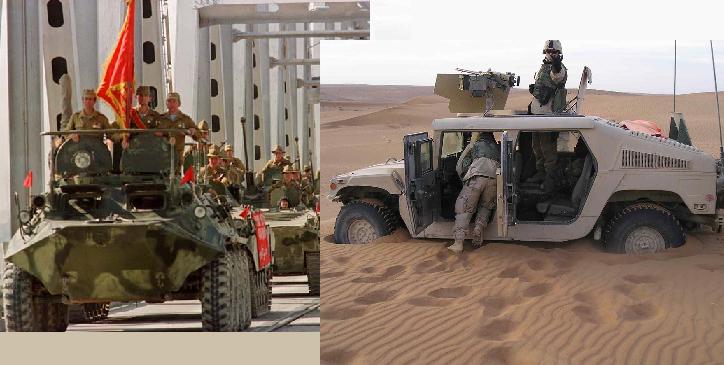
As the US prepares to “withdraw” (sic) from Afghanistan, a fiasco that has made its Soviet “prequel” seem like a Hollywood success story, two new books add insult to injury.
Written by a former British ambassador and a Russian journalist, and reviewed by Tariq Ali in the London Review of Books, “Afgantsy: The Russians in Afghanistan 1979-89″ by Rodric Braithwaite and “A Long Goodbye: The Soviet Withdrawal from Afghanistan” by Artemy Kalinovsky show the much maligned Soviet offensive in a much more nuanced light, dispelling many of the old cliches about a drunk/senile Brezhnev ordering a doomed invasion on a whim, or notions that the USSR just ‘fell into’ the war.
Contrary to conventional wisdom that the USSR planned or even desired the Communist takeover of Afghanistan, Braithwaite writes that
The principal aim of Soviet foreign policy in the region had always been to preserve Afghanistan as a neutral state. Lenin was too orthodox a Marxist to believe that tribesmen and shepherds could make the leap forward to socialism: ‘Herdsmen can’t be transformed into a proletarian mass.’
His successors were not at all pleased when, in 1973, Muhammad Daud toppled his cousin King Zahir Shah in a palace coup and proclaimed a republic. Moscow had enjoyed warm relations with the king, a genial old buffer who presided over the tribal confederation that constituted the Afghan state. The Soviet leaders were even less pleased when in April 1978 a group of communist army officers staged a coup and called it a revolution.
The irony of the USSR preferring a monarchy to a communist revolution aside, the Soviet Union had pursued a pragmatic foreign policy since even before WWII, while US policy making and conventional wisdom remained stuck in the era of Kennan’s Long Telegram well into the 1980s.
Such a disingenuously anachronistic attitude was of course very convenient for the US and its allies to frame rational Soviet strategic interests as mad, and potentially contagious, revolutionary designs.
Contrary to insinuations that the “inherently expansionist” USSR was looking for any excuse to invade Afghanistan, in reality, the Politburo was ardently and unanimously opposed to military action.
Refreshingly, Yuri Andropov, the KGB chief-turned-ailing General Secretary who briefly preceded Gorbachev before dying of kidney failure, gets a long overdue rehabilitation.
Far from the reactionary apparatchik of the Brezhnevite ‘gerontocracy’ that he is frequently portrayed in the west by dint of his KGB pedigree and dour appearance, Andropov was an astute, energetic, reformist, flexible and sensible man, with a strong conscience and liberal leanings. Furthermore, as the most senior ‘sponsor’ of Gorbachev to be his successor, Andropov was the conscious midwife of perestroika.
“Yuri Andropov, then head of the KGB, and Andrei Gromyko, the foreign minister, were contemptuous of the notion that what had taken place in Kabul was a revolution” and rebuffed calls for military assistance:
The Afghan leaders, faced with a mutiny in Herat and discontent elsewhere, pressed for Soviet ground troops. Andropov warned the Politburo that the general population would see Soviet troops as aggressors. He was strongly backed by the prime minister, Aleksei Kosygin, and the defence minister, General Ustinov.
Another interesting twist was the USSR complaining to the Afghans about human rights violations. However, it should have expected the inevitable reply:
When Aleksandr Puzanov, the Soviet ambassador, protested to Amin about the scale of the repression, he was told that the PDPA was merely following the example of the early Soviet Union.
In the end, far from gunning for an invasion, the USSR only intervened when a civil war of sorts had already begun between the two rival revolutionary factions and threatened to create an opening for the Mujahedin; Moscow moved in to shore up its candidate, the more restrained Karmal against the fanatical Amin, for the main reason that, “in their view [Amin] wasn’t capable of creating a popular coalition that could resist the mujahedin”.
So the conventional wisdom that Moscow moved in to prop up an unloved Communist government tells only half of the story: Moscow moved in to prop up a Communist government against an even more unloved, and more radically Communist, alternative.
None of this is to excuse the disastrous Soviet campaign, which claimed over a million Afghan lives and which it took three years for Gorbachev to finally end. However, contrast the pragmatic, reluctant and much deliberated Soviet engagement with the passionate, knee-jerk, almost fanatical and gung-ho attitude of the Bush administration.
Indeed, while the inevitable parallels between the Soviet and US wars were clear from the start, the latter has surpassed the former not only in duration, but also, ironically, in ideological zeal.