

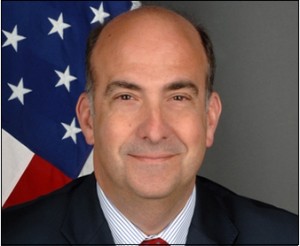
- U.S. ambassador to Haiti Kenneth Merten

American diplomats, under the leadership of U.S. Ambassador to Haiti Kenneth Merten, met the 16-member senate majority on Wednesday Aug. 24, 2011 in an attempt to break through the political stalemate depriving the country of a government, thus bringing major reconstruction efforts to a screeching halt.
More than 100 days into President Michel Martelly’s tenure, the country remained in political limbo without a legitimate government to bring needed relief to the shattered nation. The parliament vehemently rejected both of the president’s unilateral choices for prime minister: first businessperson Daniel Rouzier by the lower house and Former Justice Minister Bernard Gousse by the senate.
Bitterly divided over power sharing methodology, the executive and legislative branches actively engaged each other in a political tug-of-war, unable to move pass their ideological differences. On one hand, the Martelly administration enacted an aggressive media campaign, painting the parliament as the principal enemy of progress blocking any practical initiative guided by personal greed. On the other hand, lawmakers put the spotlight on Martelly’s unilateral approach and disregard for constitutional imperatives. Frustrations, meanwhile, grew exponentially as answers proved elusive and the level of squalor persisted, unabated.
Impatient with the actors’ inability to find a common ground, the American delegation met with six members of the opposition, urging leaders to act. Senator Jean Hector Anacacis explained that emissaries from Washington sought understanding on the position of the opposition as it related to that of the executive, hoping to unearth the key to the political gridlock.
During the meeting held in Petionville’s Morne Calvaire, a communal suburb located on the hills just east of Port-au-Prince, the six senators outlined the issues at the heart of their uncompromising stance to the delegation. The urgency of a compromise that would enable the formation of a government to forge a practical path toward rebuilding Haiti topped the agenda.
Many leaders, namely in the civil community, perceived the parliament as the body responsible for the current crisis and voiced the need for a resolution. As uncertainty engulfed soaring optimism that animated voters following Martelly’s election, the opposing majority felt compelled to justify their actions. While expressing its readiness to ratify a new prime minister, the group of 16 articulated the need for the choice of the next head of government to be constitutionally and politically binding, stressing the importance of the democratic process as leaders attempted to remedy the current situation.
Senator Wencesclass Lambert, one of the six participating members, said the American delegation wanted to emphasize how Haiti’s persisting political paralysis preoccupied the Obama Administration. For his part, Senator Anacacis characterized the meeting as useful and expressed optimism at a gradual progression toward a consensus as the lack of trust between the main actors dissipated.