


(Left to right) French President Francois Hollande, U.S. President Barack Obama and German Chancellor Angela Merkel prior to their "family photo" at the G8 summit on 19 May 2012.
2012 has been the year of elections and ideological divisions. France is no exception to the rule. On May 15th, 2012, François Hollande officially became the President of France. His first action was to fly to Berlin, despite the weather, in order to meet with German Chancellor Angela Merkel. This strategic move is important for two reasons: first, President Hollande established himself in the rupture with his predecessor, who visited London before Berlin; second, the Franco-German machine is rightfully perceived as the cornerstone of Hollande’s European policy.
However, what is quite interesting is the wide gap between the themes of the debate between French candidates for the presidency and the reality of the function. Most of the debates and programs–either in France or in the US, or even in any countries with an active foreign policy–dealt with domestic and socio-economic policies, but not foreign policy. As a foreign policy expert, it is quite disappointing to see a lack of interest in such a vital part of the job for the candidates for the highest office. In a world becoming more and more globalized, why does foreign policy barely matter on the agora? Do voters not understand that policies implemented in another region of the world will ultimately affect their lives in one way or another? A large segment of the foreign policy literature emphasizes on the fact that all politics have increasingly become “glocal.” It is true that foreign policy is fashioned by local events and citizens, but it is also undeniably shaped by the international system and shifting balances of power.
In the case of the French presidential elections, Messrs. Hollande and Sarkozy spent very little time on foreign policy. Mr. Sarkozy could not advertise on his pseudo successes considering their unforeseen consequences. For example, his Libyan campaign has cost the international community the ability to launch future military and/or civilian missions through the UN. Russia and China, rightfully, felt manipulated by the way the French led coalition used the UNSC Resolution 1973 in order to oust Colonel Qaddafi. Even though, Mr. Hollande had the edge over his predecessor throughout the last part of the race, it is quite striking that no one, outside of his close advisors, had a grasp of his visions in foreign and defense policies. So far he has appeared to be aligned with the Gaullist tradition, which has been confirmed by the recent appointment of long time socialist politician Laurent Fabius at the head of the French diplomacy.
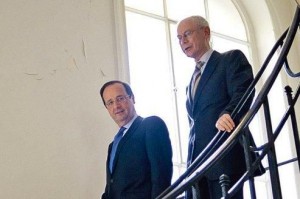

Since his election, President Hollande has been principally focusing on international questions. In less than a month, he 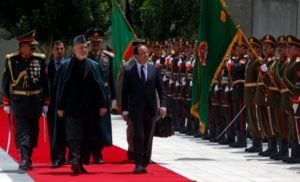

Foreign policy has been the missing element throughout the election campaign across the world. The US is in the same dynamic. The emphasis in the US has been on the debt crisis, health care, youth unemployment, housing crisis, and gay 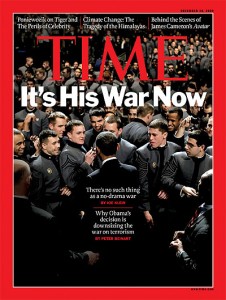

American citizens have not been very concerned with overall foreign policy issues at the exceptions of several very specific questions, terrorism and military spending, as proven by a recent poll by Pew Research Center (below). These priorities are too broad and do not reflect the changing international pressures such as the rise of the BRICS, the future of NATO, multilateralism vs unilateralism, the development and aid policies of the US, and the protection/enforcement of human rights.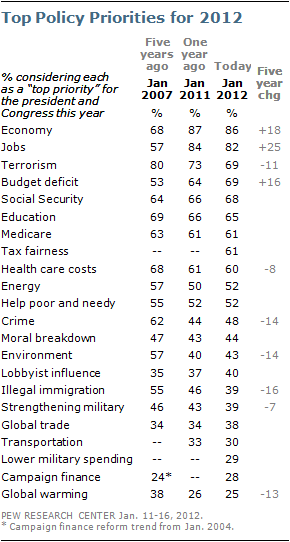

The lack of interest on the outside world in developed countries is striking. The international system and the ou

Credits:
1) Source: Pool/Getty Images North America
2) Le président élu, François Hollande, raccompagne le président du Conseil européen, Herman Van Rompuy, après une rencontre à son QG de campagne, mercredi à Paris. (Photo : Fred Dufour/AFP)
3) President François Hollande of France with President Hamid Karzai of Afghanistan at the presidential palace in Kabul on Friday. Mr. Hollande has pledged to increase French nonmilitary aid. (Photo by Omar Sobhani)
4) Pew Research Center. 2012. Public Priorities: Deficit Rising, Terrorism Slipping. January 23. http://www.people-press.org/2012/01/23/public-priorities-deficit-rising-terrorism-slipping/