


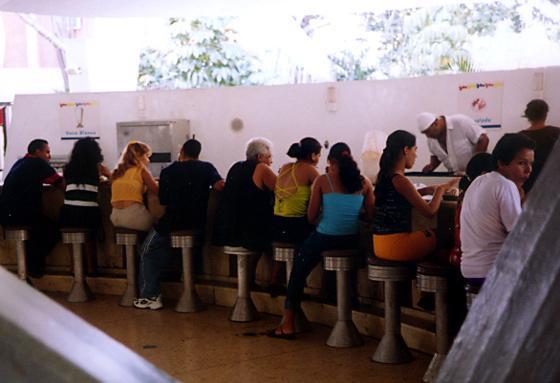
 *The photo above shows the counter at Coppelia, a Havana ice cream shop constantly crowded with people waiting to take advantage of one symbolic measure of the revolution: ice cream, a treat exclusively for the rich before, became accessible for all Cubans.*

______________________________________________
I recently had the privilege of reading a 40-year-old piece on Cuba by Ronald Steel, a US scholar, historian and recognized expert on US foreign policy. His “Letter from Havana,” from the New York Review of Books of April 11, 1968, provides a glimpse into the still-young Cuban communist state under Fidel Castro. I was struck by how many of his observations are highly relevant today.
Much of the argument of his “Letter” can be summed up in his final sentence:
[Cuba] is a country, an experiment, a state of mind, quite unlike any other; a seductive place that is perhaps dangerous to take at face value, but impossible not to admire for the courage of its people and the daring of its vision.
Cuba in 1968 was “the Cuban experiment,” a revolution in progress where trial-and-error was the order of the day and the great ambitions of the country were (1) to eliminate social inequities that had polarized the country for years and left many in poverty, (2) to survive the hostility of the island’s closest neighbors, and (3) to mobilize the entire society in the task of economic development. First-hand witnesses understandably found it hard not to be seduced by the spirit of hard work and moral obligation to one’s neighbor that permeated the island and that, when coupled with a truly Caribbean passion and intensity, made it truly unique from the Eastern European communist states of the day.
One could hardly ignore the benefits to Cubans of the elimination of illiteracy on the island, the doubling of students enrolled in school, and the free services provided by the state, which already at that time included local telephone calls, medical care, meals on the job, education, day nurseries, wedding banquets, funerals and sports contests. Free rent and provision of basic foods followed soon afterward.
And it was difficult not to admire the ability of Cubans to survive the US economic embargo, Steel said, and to brave the hostility of neighboring countries that had cut all cords connecting Cuba to the rest of the Western Hemisphere—with the exception of one propeller-driven plane that flew roundtrip between Havana and Mexico City twice a week.
And even then (in 1968), he argued:
[T]he blockade, although it has caused considerable hardship and inconvenience, has not threatened the stability of the regime, and has proved to be an economic failure… The fears of some Americans about the dangers emanating from this communist state “only 90 miles from our shores,” seem rather ludicrous from Havana, where the American colossus—which sends its reconnaissance planes over Cuban skies, its warships outside Havana harbor, and has its own troops on Cuban soil at Guantánamo—sits only 90 miles off their shores.
All these factors nearly distracted the onlooker from recalling the grievous economic mistakes the regime had made; the consumer shortages that plagued Cubans; the thousands of political prisoners that were incarcerated in Cuban jails; and the troublesome lack of a parliament, a free press, and a constitution guaranteeing civil liberties. The government was ruthless with those it considered to be dangerous enemies, dispensing “revolutionary justice” that meant secret trials and indefinite prison terms. Homosexuals and other undesirables were confined to forced labor camps for years after the 1959 revolution.
Today, the years of trial and error have not come to an end. Raúl and his economic advisors continue to experiment with new initiatives to spur production and efficiency. And the socialist Cuban state survives, despite decades of embargo and a difficult period following the fall of the country’s main source of support, the Soviet Union. One naturally feels a certain respect for the small state’s stubborn insistence on survival in such a hostile context. Slowly, Cuba has increased its friend base, so that now the United States is the only country without official diplomatic relations with Havana.
Ultimately, the cautionary note implicit in Steel’s “Letter” still applies. The abuses of the regime continue, the state still holds political prisoners, and civil liberties remain severely constrained. Cuba’s strength in the face of adversity may be admirable, but neighboring countries and international partners must not let this overshadow the persistent problems that plague Cuban society.
(A travel and economic embargo is not the answer, but nor is a relationship that ignores questions of human rights and civil liberties.)