


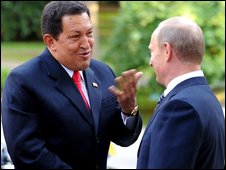

The Economist magazine wrote an interesting piece last week on the building tensions between the two countries. The closing of successful trade ties, Colombians and Venezuelans being murdered at the border, Colombian’s increasing support for Mr. Uribe, and the lack of will for average Venezuelans for any war, never mind a one hundred year war, was the main focus of the article. Regarding security, the author claimed that Colombia’s well trained forces would likely be too much for Venezuela’s army, with the exception of new Sukhoi fighter bombers purchased from Russia over the last few years and new equipment in recent months. In reality, the security situation is more complex, as old powers and new powers race to establish ties in Latin America and Africa. Growth in some Latin America economies have brought much attention to the region, while security concerns have also been portrayed as being in the centre of a global security debate involving China’s economic influence, Iran’s nuclear ambitions and US hegemony in its own backyard and abroad.

Recent active policy from China to secure markets which many Western countries tend to neglect or put trade conditions on have been the target for much of China’s limited expansion abroad. This has been economic in nature, but much of the wealth has also gone into updating China’s military capabilities by developing new aircraft and weapons locally and contracting and licensing the production of Russian weaponry to be made in China, along with buying much of the equipment outright. China has been opening trade ties with many countries in Latin America, through credit agreements and investments in the region as well. Some policy experts have claimed that the interests in the region have gone beyond economic, as talks of deep water ports and links with Cuba and Venezuela surface. While no concrete actions have taken place, the suggestions of deep water ports, which are signs of placing a blue water navy beyond local seas, could become a major issue in the future as the US and China seek to balance their power and security abroad.
Chavez this past year has taken great strides in solidifying Venezuela’s relations with Libya and Iran, visiting the Middle East and becoming a media partner of both leaders on several occasions. He even went as far as claiming Colombia was Latin America’s Israel, albeit while maintaining many of his ties with the Jewish community in Venezuela. The latest security issue on the world stage, Iran’s nuclear capability, also has a dimension in Venezuela as reports of open trade and technology transfer between the two nations grow. Claims by Chavez that a nuclear program with help from Iran would be of interest to Venezuela have also become an issue of some concern. While Iran’s “peaceful” nuclear program is a question of much debate, the suggestion that Venezuela might seek its own program with help from Iran may escalate the security situation in Latin America to become not one of a hundred year war, but one that would illicit a quick reaction from Venezuela’s adversaries, especially that of the US. Nuclear weapons near a US border from Iran would likely create massive support in the US against Venezuela, even with an Oliver Stone documentary in the works. As the Economist article suggests, while it is likely Chavez is simply posturing, there may be a point where a suggestion of war may become a reality..even if it is not intended.