


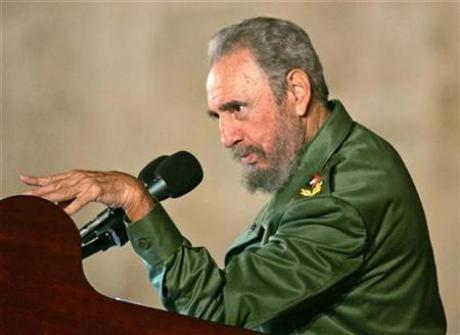
U.S. President Barack Obama has been the inspiration for a number of Fidel Castro’s “Reflections,” which run in Cuba’s state-run press regularly. Castro has praised Obama for his efforts to reform healthcare, questioned his commitment to improving relations with Cuba, and recently, called his acceptance of the Nobel Peace Prize “a cynical act.” For decades, Fidel has shown a knack for inserting himself into the global discussions of the moment with his commentary, and his monitoring of President Obama has been no exception.
His most recent critique of Obama and of the United States—“the empire”—came today. Through a written message read aloud by Venezuela’s Hugo Chávez, Fidel told the summit of ALBA (Bolivarian Alternative for the Americas) leaders gathered in Havana this week that “the empire’s real intentions are obvious, this time beneath the kindly smile and African American face of Barack Obama.” He said that the United States is in fact backing rightist movements in Latin America in a bid to weaken Chávez and other regional socialist leaders.
His comments are in large part a reaction to the U.S. agreement with Colombia to station U.S. military personnel at seven Colombian bases, which some South American nations have considered a sign of aggression by the United States.
Besides confusing the portion of the U.S. domestic opposition that calls President Obama “socialist,” Fidel’s comments might stump the Obama administration itself, whose general approach to Latin America so far has been to lay low, eschew the historic interventionist style of the United States in the region, and attempt to support regional institutions and leaders in addressing issues as they arise. This was the approach to the crisis in Honduras this year, in fact, and yet Washington ended up receiving criticism even from Hugo Chávez for failing to do more to restore Manuel Zelaya to the Honduran presidency. Obama’s frustrated response in August was: “The same critics who say that the United States has not intervened enough in Honduras are the same people who say that we’re always intervening and the Yankees need to get out of Latin America.”
A dilemma, to be sure.
The first problem with that statement, however, is an assumption that the United States even has the ability to “lay low” in Latin America. Historic legacy and complex interdependencies, particularly with the closest neighbors in Mexico, Central America and the Caribbean, make the very concept of pure spectatorship impossible.
The second problem is the black and white dichotomy presented, as if there were no middle ground. It is true that the United States cannot sit still and do nothing during a crisis in Latin America, and that at the same time, Washington cannot impose its will through intervention as it did only a generation ago in the region (which is what leaders like Chávez and Castro are quick to point out). But inaction or intervention is a false choice: these are not the only two options, despite Obama’s lament. Leadership, in concert with regional groups and heads of state, is the middle ground that many Latin American leaders seem to be demanding from Washington, and that they are not yet seeing demonstrated in policy. And although not all Latin American heads of state will be satisfied with any given U.S. policy applied through such means (the region is incredibly polarized between leftist leaders and more conservative ones, after all), perhaps the title of “empire” will begin to wear off that way.
Castro’s critique this week arises from this very issue, as Washington did not consult with South American leadership while the details of the Colombian agreement were settled. The bilateral agreement took many by surprise and offended Brazil, Venezuela and others who believed that foreign military in a neighboring country should certainly be their concern, particularly if they were to be convinced that the presence would be benign to their sovereignty.
… And without transparency and consultation in the region, Washington makes it difficult to offer evidence to counter Fidel, even when, as in this case, his accusations are far-fetched and based in another era.