


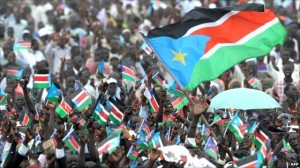
Photo Credit: BBC News
In a historic ceremony Saturday, South Sudan became Africa’s 54th nation. Independence from North Sudan came after a U.S.-backed referendum in January, and represents the culmination of over 50 years of conflict.
New York Times columnist Jeffrey Gettleman raises an interesting question over America’s fixation on Sudan. The large country found a place at the top of national causes over other war-torn regions, like the Democratic Republic of the Congo, where conflicts have claimed around 5 million lives (compared to Darfur’s 300,000). Gettleman offers one explanation, with the help of Georgetown professor John Voll: “[Sudan’s] internal conflicts were easily reduced by outsiders to Manichaean absolutes of oppressed Africans, many of them Christians, getting crushed by Arabs, ‘with echoes of the Crusades.’”
Indeed, conceptions of a Muslim (and Arab) dominated north against a Christian south led to the popularity of South Sudan’s cause among Christian groups in the U.S., who have been championing independence for decades. President George W. Bush made Sudan a foreign policy priority when he was elected. The famous Christian helped broker the 2005 deal that promised an eventual splitting of the state.
The religious lens is a difficult one, especially when regional background becomes conflated with religious ideology- such as “Arabs vs. Christians.” And reducing U.S. response to a Christian mission is certainly a mistake. But simplifying tensions does have an important effect on mobilizing interest. Rather than untangle decades of conflict, with no clear division between “good guys” and oppressors, an overarching narrative helped spark the interest of humanitarian groups across the nation (and key celebrities).
Yet real international focus did not come until after reports of mass atrocities in the western region of Darfur in 2003. Professor Voll argues that it was the debate around genocide in Darfur that really drove international interest in Sudan.
“This gave the Darfur cause a distinctiveness that could gain real support… There were few other conflicts at that time that could so easily be called ‘genocidal,’ even though the conflicts in Congo were, and are, more destructive.”
Whatever combination of factors have impacted U.S. involvement, the legacy of former President Bush’s role is clear. In photos from the weekend, South Sudan’s new president, Salva Kirr, stands out wearing a gift from the former U.S. leader- a large black cowboy hat.
The news of South Sudan’s independence is a huge step towards resolving a half-century-long conflict. The relatively peaceful final resolutions are proof of the favorable impact international brokering can have. However, the conflict is far from over. As aptly summarized by Gettleman:
But South Sudan — Texas-size and with about eight million people — is already plagued by ethnic tensions and rebellions. More than a half-dozen renegade groups are battling the government, some with thousands of fighters. And relations with the north are still dicey. Negotiators have yet to agree on a formula to split the revenue from the south’s oilfields, which have kept the economies of both southern and northern Sudan afloat. And Mr. Bashir’s army has been pounding southern-allied rebels who have refusing to disarm just north of the border in the Nuba Mountains, which some analysts worry could drag the whole region back into a full-scale war.
Along the same lines, UN Secretary General Ban Ki-moon warned of the importance of continued international support in both Sudans. It is imperative, he argued, that the new nation secure relations with neighboring countries, especially their former enemy to the north. “A priority for both countries is agreement on their common border, sustainable relations to ensure both states can benefit from the oil revenues in the region, and cross-border arrangements to continue their strong historical, economic and cultural ties,” he wrote.
As Ban Ki-moon urges the international community to understand, South Sudan’s monumental weekend is only the beginning.