


Photo Credit: Los Angeles Times
The 18 day protests that ousted the once thought unmovable Egyptian leader Hosni Mubarak have been heralded as a model for thousands struggling across the Middle East. Yet how is Egypt faring four months after those fateful days? Months after reporters left, where does Egypt stand?
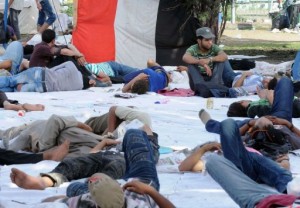
From the recent reports of protesters’ return to Tahrir Square, the initial answer is: uncertain. For the past six days, images from Cairo have evoked memories of February- thousands of sit-ins block major roads and government buildings, the square a sea of make-shift tents. Current protesters call for the removal and prosecution of former Mubarak government officials, as well as police involved in the deaths of nearly 900 February protesters. Yet for many, the return to the streets represents a larger dissatisfaction with Egypt’s post-revolution state. The recent crowds, also mounting in Suez and Alexandria, express frustrations over slow paced reforms, an ineffective justice system, and the dashed promises of the revolutionary spirit.
“What protesters have been asking for consistently since the end of the revolution has been free and open trials for members of the former regime as well as policemen and police officers involved in the killing of protesters throughout that 18-day revolution,” Al Jazeera’s Ayman Mohyeldin reported from Cairo.
Transitional Prime Minister Essam Sharaf has made promises to remove former Mubarak officials, accepting the resignation of unpopular deputy Prime Minister Yehia el-Gamal Tuesday, and according to Reuters, agreeing to the dismissal of 650 senior police officers. Yet protesters remain frustrated with the slow pace of change, and what they see as empty statements from the capital.
“There is a gap between the revolution and the swiftness it was demanding,” Amr Moussa, former Arab League secretary-general and a presidential hopeful reported to Al Jazeera.
Currently the country is run by an army-appointed transitional cabinet, the Supreme Council of Armed Forces (SCAF), who promise elections before the end of the year. Many, however, seem to have grown wary of the transitional government. “The armed forces, which were hailed as heroes at the start of the January 25th uprising for not shooting on protesters, have come under fire for using Mubarak-era tactics to stifle dissent and maintain an absolute grip on power,” Al Jazeera reports.
The rapidness with which Mubarak was overthrown was remarkable, but the removal of a dictator is hardly the end of a revolution. New York Times journalist Anthony Shadid tells of a sign hanging from one of the tents in Tahrir: “Our mistake,” it declares, “is that we left the square.”