


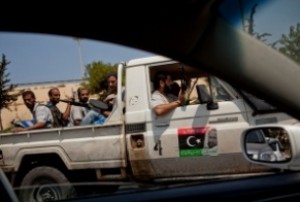
Bryan Denton for the New York Times
Overnight on Sunday, the news from Libya turned from questionable progress (on any front), to reports of jubilation, as rebel forces drove through Tripoli, securing the majority of the city and arresting two of Qaddafi’s sons. Reports Monday claimed Qaddafi loyalists control a mere twenty percent of the Mediterranean city, localized to the ruler’s expansive compound.
In the wake of this rapid early success in the capital, the head of Libya’s National Transitional Council (NTC), Mustafa Abdel Jalil, announced that while the rebel journey is far from over, Qaddafi’s era has reached its denouement; a sentiment echoed by President Obama Monday.
Meanwhile, Al Jazeera prompted readers to follow a section entitled “Libya: The Endgame,” and the New York Times reported that European leaders are scrambling to find and support a future plan for Libya. It appears the media jumped on a glimmer of positive news in an erratic situation. With Qaddafi’s location still uncertain, many have interpreted his recent silence as acknowledgement of an impending defeat.
However, reports from Tuesday paint a more complex, indeed more accurate, picture. Qaddafi’s son, Seif al-Islam, who was supposedly in rebel custody mere hours ago, surprised foreign journalists by speaking at a hotel where many reporters are currently based; he called for resistance forces to continue their battle, and claimed his father was safe in hiding. This sudden appearance raises questions over the strength and unity of the rebel armies. As intense fighting continues across the city, it is clear the battle for Tripoli cannot be won overnight.
In the U.S., policy makers are closely following the unraveling situation. Some experts have jumped to draw comparisons and lessons from Iraq. Libya’s case is interesting, from a U.S. foreign policy perspective, in that world leaders may have succeeded in employing a coalition force – theoretically concerned only with the welfare of the Libyan people. Indeed, French and British engagement has been heralded by President Obama as the anti-Iraq method of international involvement, a model, perhaps, for future peace-waging missions. Yet with so many hands in the game, are Libyan rebels at risk of becoming pawns in greater international politics? Can they use an array of countries’ interests to their advantage, or will the coalition prove to be an impediment to effective decision making?
Experts note that the notable absence of institutional structures will be the biggest impediment in the days and years to come for those who wish to rebuild Libyan society. David Mack, a scholar at the Middle East Institute and a former U.S. diplomat to the Middle East, reported to NPR:
“In Libya’s case, you don’t just have an authoritarian leader who stayed too long. What you have in addition is a country without a political structure on which you can build a democratic structure. Libya was scarcely ready for independence when it received it in 1952. The monarchy didn’t develop it. Gadhafi squandered it. A lot of things have to be done from scratch and it’s going to be very difficult.”
The necessity of total repair signifies that rebel forces cannot act alone. According to many pundits, external forces have an obligation, and are indeed required, to lend a hand, though these same activists are quick to add any decisions will stem from Libyan actors alone. Yet important questions are being asked by mainly Western policy makers– including the prospects for ground troops (NATO, individual national missions, or UN peacekeepers), security structures, coalition rulers, and the probability of future violence. Is this international response a positive development? Or does it merely highlight the hypocrisy of Western intervention? As Syria continues to receive “harsh words,” British Prime Minister Cameron cut his vacation to address a future plan for Libya, French President Sarkozy has asked rebel leaders to attend an urgent meeting in Paris next week, and the U.S. continues to negotiate through diplomats working in the rebel stronghold Benghazi.
Some will argue this foreign engagement is both welcome and necessary, especially since the U.S. and E.U. have committed NATO forces to the conflict. But will these Western actors be able to unite behind policies that are in Libyan civilians’ best interests? Will individual opinions on the best ruler or methods of achieving security hinder any sense of Libyan agency? It is worth mentioning that Libya was formerly Africa’s fourth-largest oil producer, and about 80% of the country’s oil exports were allocated to France and Italy. The number of actors at the table is no accident, and it should not be assumed that sovereign nations will resign their own interests in Libya.