

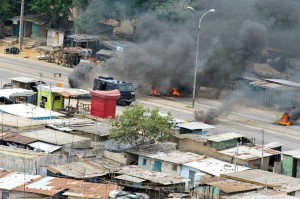
The year 2011 saw dramatic changes in Africa’s landscape. The unprecedented sweep of the North African uprising has endangered the lives of in Egyptians, Libyans and Tunisians. Instability caused by election disputes in Côte d’Ivoire and Zimbabwe coasted the lives of thousands of protesting. The long waited independence movement of South Sudan has come to an end. The disastrous drought in the Horn of Africa, touted to be the worst in 60 years, has affected an estimated 12.4 million people in areas of Djibouti, Eritrea, Ethiopia, Kenya and Somalia. In short, 2011 has been a year of the unexpected and active ferment in Africa.

On 17 December 2010, twenty-six year old Mohamed Bouazizi doused himself with a flammable liquid and set himself on fire to express his frustrations over the authorities of Sidi Bouzid, 190 miles south of Tunis. Public outrage quickly grew over the incident, leading to the end of Ben Ali’s rule in Tunisia. Though the bulk of protests followed Bouazizi’s self-immolation and led to the departure of Ben Ali, demands for greater political freedom, economic opportunity, and an end to systemic corruption, has resonated deeply across the continent and the Arab world.
Globalization and modern technology now enables social movements to transcend borders as rapidly as ideas can. The protest that began in Tunisia, subsequently spreading to Egypt and then to Spain, have now become global – with the protests engulfing Wall Street and cities across America and Europe. Such public anger continues to challenge the present and will have implications for setting precedence in governance norms, stability, and development across civilization. In Mauritania, for example, Ould Khatry set himself on fire at the gates of the presidential palace shortly after the downfall of Ben Ali. Khatry’s final post on his facebook page demanded “legitimate rights,” the release of activists from prison, and a constitutional amendment banning all current and former military figures from seeking the presidency. In Morocco, the government dramatically reshaped state-citizen relations in that long static nation.
With tentative steps toward democracy, the long held assumptions of public passivity and the violability of stable, autocratic states in Africa have withered. Winds of change visited Guinea, Côte d’Ivoire, Niger, Nigeria, and Zambia, among other places. Indeed, protests demanding more political liberties, services, and accountability were seen in Burkina Faso, Uganda, Senegal, Benin, Malawi, Kenya, Djibouti, Mauritania, Cameroon, Gabon, Guinea-Bissau, and Swaziland in the months following the launch of the North African uprising. Exceptionally, Nigeria, with a population equal to and oil production roughly 60 percent of all of North Africa, held presidential elections in April 2011 that were widely regarded as free and fair. Exhibiting higher levels of transparency and oversight than any election since Nigeria broke from military rule in 1999, this achievement represented a major step forward in the country’s march toward democracy.
April 2011 also saw the upholding of presidential elections in Côte d’Ivoire — undertaken in November 2010. The, Laurent Gbagbo, had refused to recognize his electoral loss, despite pronouncements from the country’s electoral commission, the Economic Community of West Africa States (ECOWAS), the African Union (AU), and the United Nations. Defying calls for him to step aside, The outspoken historian instead attempted to use his control of the armed forces to hold on to power. However, the near unanimity of the international community, backed by sanctions, left the eloquent historian increasingly isolated. After months of stalemate and escalating tensions and violence, Gbagbo was arrested by forces loyal to the electoral victor, Alassane Ouattara.
In Niger, military officers restored authority to a popularly elected civilian leader one year after seizing power from President Mamadou Tandja, who repeatedly attempted to bypass the constitution to perpetuate his stay in power. In Guinea, democratic elections in November 2010 brought Alpha Condé to power, ending more than 40 years of near continuous military rule, including a 2008 coup by Captain Daddis Camara. The elections were further notable in that the losing candidate in the closely contested outcome, Cellou Dalein Diallo, graciously accepted defeat and facilitated Guinea’s first steps toward a democratic political system.
The year also sparked a series of troubling developments in Senegal, Malawi, and Benin, where elected leaders have attempted to alter electoral rules, orchestrate familial successions, employ violence to break up peaceful protests, and restrict the media. Repressiveness and terrorization of citizens in Equatorial Guinea, Eritrea, Ethiopia, Rwanda, Sudan, and Zimbabwe — where even watching the North African protests on television has been grounds for imprisonment. The episodes in Kenya and Zimbabwe where incumbent presidents also refused to step aside after they were widely perceived to have lost electoral bids led to the death of hundreds of protesting civilians. In Uganda, the petrified Museveni ordered mobile operators to intercept and block SMS messages containing the following words during the February 2011 national elections: “Egypt,” “Tunisia,” “Mubarak,” “dictator,” “Ben Ali,” and “People Power.”
Recognizing the still unfolding nature of these phenomena and the many complex countervailing forces at play has broader relevance for Africa’s democratic trajectory. In particular, how sustainable are these democratic advances? How serious are the prospects for further democratic transitions across the continent? And what, if anything, can regional and international actors do to support these reforms?
According to African democracy experts, the key analysis of the North African experience must be understood in the much larger and longer-term context of Africa’s democratic evolution. While highly varied and at different stages of progress, democracy in Sub-Saharan Africa is not starting from scratch, unlike in most of the Arab world. Considered from this broader and more heterogeneous perspective, the direct effects of the North African uprising on Sub-Saharan Africa’s democratic development are muted. There are few linear relationships linking events in North Africa to specific shifts in democratization on the continent.
That said, the angst and frustration propelling the protests and unfolding transitions in North Africa, particularly Egypt and Tunisia, resonate deeply with many Africans who are closely following events in the north. The uprising is thus serving as a trigger, rather than a driver, for further democratic reforms in the continent. There have been contentious, dormant and evolving protests in more than a dozen African capitals demanding greater political pluralism, transparency, and accountability. Likewise, a number of African governments are so fearful of the North African uprising influence that they have banned mention of the term on the Internet or public media.
There is no doubt that the democratic protests in North Africa will teach the important lesson that democracy is not bestowed on but earned by its citizens. Despite the major social, cultural, and economic differences between North and South, the mass protests in Tunisia, Egypt and Libya have riveted the attention of millions of Africans from all walks of life. Expressions of frustration with political exclusion, corruption, yawning inequality, and impunity seen on the streets of have resonated deeply across the continent. In this context Africa is undergoing a complex process of multiple transformations. Solutions to some of these cases have been found from within, coupled with external support. For this reason, it can be argued that part of the solutions to the conflict situation and political instability in Africa lies in the West. More specifically is for the Western governments to address the issue of arms manufacture and sale of arms, weapons to Africa and to address the conduct of their multinational involvement in extractive activities at the expense of African lives.