


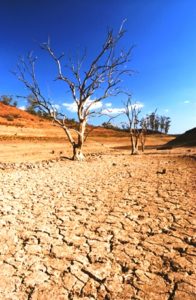
Dried lake; Source: http://blogs.worldbank.org
In a recently published study in the journal Environment Research Letters a team of scientist argue that “the total volume of water in aquifers underground is 100 times the amount found on the surface“. They also have produced an impressively detailed map of the scale and potential of the groundwater reservoirs.
This finding could be a game changer for the lives of as many as 300 million people without access to clean and safe drinking water throughout the African continent. African countries formerly labeled as “water scarce“ could be relabeled. Dr. Helen Bonsor, one of the scientists conducting this research from the British Geological Survey pointed to the “greatest groundwater storage in northern Africa, in the large sedimentary basins, in Libya, Algeria and Chad. The latter is one of the poorest countries on the planet evidenced by its economic indicators. The map also shows clearly that the storage capacity of aquifers across much of Sub-Saharan Africa is much lower.

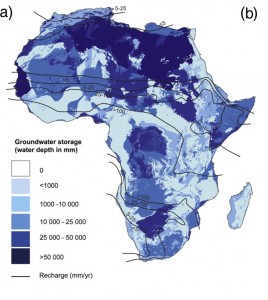
Groundwater ; Source: Environment Res. Letter 7 024009 2012
However, the scientists also point to a caveat: Even though there seems to be a huge amount of groundwater reserves in Africa to cope with the implications of climate change such as longer drought periods, governments in the respective countries need to be careful in how to explore and exploit those water reserves for drinking and small-farming irrigation. In this respect, it is very interesting and at the same time crucial to note – as Matt McGrath points out in his article for BBC News– that changes in the climate over 5,000 years ago have turned what is known to us as Sahara into this incredible desert of today. Consequently, the aquifers underneath were last replenished with water millenia ago. Given that many aquifers would not be filled due to an obvious lack of rain in many regions, large-scale drilling could rapidly deplete the existent water supplies. According to Dr. Bonsor, “even in the lowest storage aquifers in semi arid areas with currently very little rainfall, ground water is indicated to have a residence time in the ground of 20 to 70 years.” Thus, smart extraction is advisable. Otherwise, as recent decades illustrate, global groundwater depletion will continue soaring. As for the implications of that, I would like to cite Marc Bierkens of Utrecht University (Netherlands): “If you let the population grow by extending the irrigated areas using groundwater that is not being recharged, then you will run into a wall at a certain point in time, and you will have hunger and social unrest to go with it.”

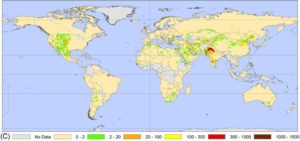
Global map of groundwater depletion, measured in cubic meters of water per year; Source: http://phys.org/news204470960.html
Overall, this research is good news because water is probably the most important driver for human development. I have written in a past article “Resource Depletion Worse For Mankind than Climate Change?” on how the global water scarcity is linked to population growth, industrialization, urbanization and power generation.