


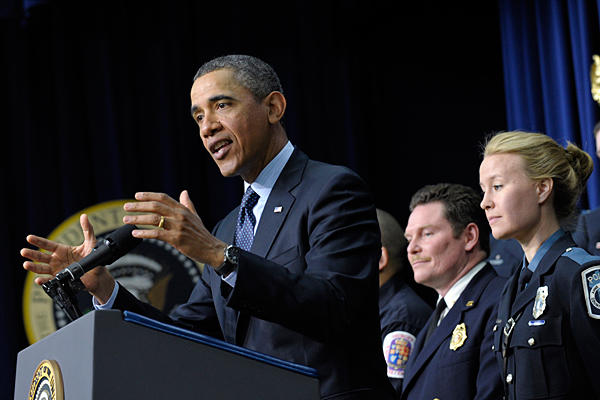
President Obama speaks about the sequester with emergency responders at the Eisenhower Executive Office building in the White House complex Tuesday. This is a group of workers that the White House says could be affected if state and local governments lose federal money as a result of budget cuts. [Susan Walsh/AP]
More “Great Decisions” reviews this week — be sure to check out Allison Kushner’s review of “Red Line: Iran, Israel and the Bomb.”
Around the Web:
The Pope and the Spy Who Loved Him
By Sean Flynn
GQ
With Benedict XVI heading into retirement, Sean Flynn digs around last year’s leak from the Vatican (VatiLeaks, as it were), only to find there are many more layers to the cloak-and-dagger scandal that’s plaguing the church than meets the eye.
Want to Work in the White House?
By Rosa Brooks
Foreign Policy
Not surprisingly, getting a job as a political appointee isn’t easy, and, as one current appointee put it, “the selection of the Pope is probably clearer.” Here’s a helpful, albeit unofficial, guide to landing a desk at 1600 Pennsylvania Avenue.
When the Jihad Came to Mali
By Joshua Hammer
New York Review of Books
According to one investigative journalist, Mali would have been seized by the jihadists in three or four days had the French not intervened. At the same time, many say blame lies also with Mali’s western benefactors, who ignored the signs that the country’s army was outmatched and opportunities to act against the extremists.
What Did Arafat Get for Killing U.S. Diplomats?
By Andrew B. Wilson
The American Spectator
Today, March 1, marks the 40th anniversary of Black September Organization’s takeover of the Saudi Arabian embassy in Khartoum, which ultimately led to the killing of three westerners, including two Americans, Curtis Moore and Ambassador Cleo Allen Noel, Jr. Even though the operation had Arafat’s approval, he came away scot-free — eventually going on to receive the Nobel Peace Prize.
When Kerry Stormed D.C.
By Marvin Kalb
The National Interest
John Kerry was only five years out of Yale when he got his first taste of the Senate Foreign Relations Committee in what was one of the more memorable testimonies on the Vietnam War. Now 42 years and several promotions later for Secretary Kerry, Marvin Kalb reflects.
Blogs:
Old Thinking, New Realities by Jodi Lieberman
A “So-Mali” Solution? by Tom Squitieri
EU-U.S. Free Trade Agreement – Why the American Push Forward Now? by Roman Kilisek
Cowboys and Indians in the Arctic by Mia Bennett
Cyber Espionage: Reducing Tensions Between China and the United States by Franz-Stefan Gady