


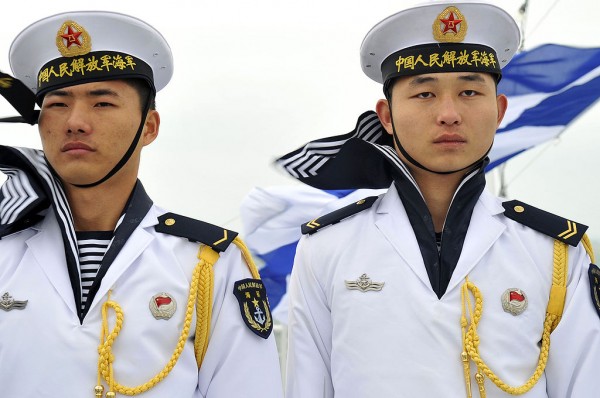
People’s Liberation Army (PLA) Navy Sailors/ Tiffini M. Jones
During his first visit to Vietnam this Monday, Secretary of State John Kerry announced the U.S. will contribute $35 million to southeast Asian nations to strengthen their maritime security. $18 million of the sum will go to Vietnam to “enhance capacity of coastal patrol” which includes buying five patrol-boats for the coastguard. Secretary Kerry stated that this announcement was not a response to recent events in the region, but a “part of a gradual and deliberate expansion” the Obama administration has been working on for some period of time.
However, it cannot be denied that this announcement has come at a critical time as relations between China, its neighboring countries, and America is increasingly tense. On December 5, the U.S. and China narrowly avoided collision in the South China Sea when a Chinese naval vessel cut across the bow of an American cruiser. This near collision was not publicized until December 13. Rivalry between the two nations has been growing as China works towards aggressively strengthening its naval power over a region the U.S. has dominantly overseen since World War II.
China’s usually precarious relations with its neighbors has also taken a turn for the worse due to its recent increasingly assertive moves regarding disputed territories over the South China Sea and East China Sea. The countries involved in these territory disputes with China include Japan, South Korea, the Philippines, Vietnam and Thailand.
These recent events in the region, especially China announcing a new Air Defense Identification Zone (ADIZ) in the skies over disputed islands between China and Japan, has further complicated U.S. and China relations. The U.S. has stated its neutral stance over the conflicting sovereignty claims, and voiced its hopes for the members of the Association of Southeast Asian Nations to resolve this difficult issue through negotiations quickly. Although the U.S. is likely to be more restrained in discussing issues regarding this matter, especially when dealing with a reclusive Chinese government, it is clear the government has great interest in getting all nations involved to reach a quick resolution Stability in the region and between the numerous Asian nations involved is integral to U.S. economic and national interests.