
Foreign Policy Blogs

Taxpayers Earn +23% on Goldman Sachs TARP Repayment

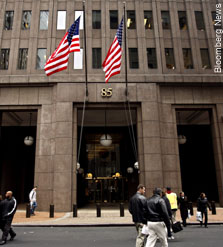
Goldman Sachs' Broad St HQ (NYC)

Goldman Sachs' Broad St HQ (NYC)

July 22 (Bloomberg) — Goldman Sachs Group Inc.’s repayments to the government of last year’s bailout money, including an agreement today to repay warrants, generated a 23 percent annualized return for U.S. taxpayers.

Goldman Sachs agreed to the Treasury’s request for $1.1 billion to repay warrants the government received when it invested $10 billion in the New York-based firm last October. The payment is in addition to $318 million in preferred dividends.

That 23 percent return compares with the 42 percent surge in Goldman Sachs’s share price since October, and the 5.1 percent gain in the Standard & Poor’s 500 Index. Goldman’s decision follows criticism of the bank by lawmakers who questioned its decision to set aside a record $11.4 billion to pay employees in the first half of the year.

Atlantic magazine: Goldman Sachs makes us all rich.

The company’s warrant transaction “was the best deal for taxpayers yet,” said Linus Wilson, a finance professor at the University of Louisiana at Lafayette.
gs-corp-logo-imageThe firm is paying about 98 percent of the warrants’ value, based on Wilson’s use of the Black-Scholes and Merton option pricing models. By contrast, he estimates that BB&T Corp. and U.S. Bancorp have struck deals with Treasury to pay less than 60 percent of the value of their warrants.

Unlike JPMorgan Chase & Co., the second-biggest U.S. bank by assets, Goldman Sachs agreed to pay the full amount sought by Treasury for its warrants. New York-based JPMorgan, which has repaid $25 billion it received from the government, said earlier this month that it couldn’t agree with the government on its warrants’ value, leaving them to be sold in a public auction.

Read more here . . .

     
    Add a comment

    Comments (2)

    1. Is This A Joke? Friday - 04 / 11 / 2011 Reply
      LOL! the best deal? Everyone got foreclosed on, while Goldman Sachs and the like got bailed out of the mess they help create. Talk about denial. People are now out of jobs and Goldman Sachs is doing great perfectly fine, due to corporate welfare (which is socialism, i may add). yes, the best deal, right. a denial. in a truly free market, in a true capitalistic system: failures die, they don't get bailed out. what a joke.
      • banker Monday - 14 / 11 / 2011 Reply
        so goldman is the reason these people bought houses they shouldnt have? Its everyone's fault my man, heres why; The banks should not have lent money to people that didnt have sustainable incomes, or make enough in general. The government that oversees loan from banks to indivduals not only, did nothing, but they deregulated their 'rules' allowing banks to lend 110% of the value of a house. AND, lets not forget the people who actually bought the house. Just cause someone gives you something (a loan) doesn't mean its a good idea. The government MADE Goldman Sachs (and every other large bank) take the 'bailout' money. Thats a fact! look it up. They did this to make sure the banks were well capitalized just in case the markets got even worse for liquidity purposes. The banks used that money, to stabilize them and then repaid with large percentage of interest. You're statement above is inaccurate and headlines kill the banks but the fact is, the 'people bailing out the banks' is simply inaccurate. More jobs would have been lost if a major institution failed. The government made a huge return on its money for lending emergency liquidity to the banks. So, you're welcome

    Add a comment


    Study International Affairs in New York City

    Author

    Elison Elliott
    Elison Elliott

    Elison Elliott , a native of Belize, is a professional investment advisor for the Global Wealth and Invesment Management division of a major worldwide financial services firm. His experience in the global financial markets span over 18 years in both the public and private sectors. Elison is a graduate, cum laude, of the City College of New York (CUNY), and completed his Masters-level course requirements in the International Finance & Banking (IFB) program at Columbia University (SIPA). Elison lives in the northern suburbs of New York City. He is an avid student of sovereign risk, global economics and market trends, and enjoys writing, aviation, outdoor adventure, International travel, cultural exploration and world affairs.

    Areas of Focus:
    Market Trends; International Finance; Global Trade; Economics

    Contact