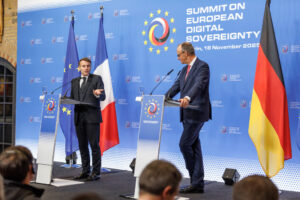
In November 2025, the European Union crossed a decisive threshold in its effort to safeguard its digital backbone from strategic vulnerabilities linked to Chinese technology. On November 10, Vice-President Henna Virkkunen introduced a legally binding proposal requiring all EU member states to phase out Huawei and ZTE equipment from their 5G and future telecommunications networks. […]
A few months ago, I wrote about the early stages of the conflict in Ukraine through the lens of Sun Tzu’s The Art of War. While it appears likely that the war will carry on into the foreseeable future, enough time has passed for us to make an honest assessment of each side’s relative […]
The Ukrainian Army has made dramatic strides in the last few weeks. Ukraine’s tactical commanders have outfoxed their Russian counterparts, and by issuing a feint towards the south the UA has been able to earn substantial gains in the north of their country. The impact of these efforts have been compounded by the steady stream […]
The “proxy paradox”, namely, the fact that the “Donetsk and Lugansk People’s Republics”, which for 8 years have been completely subsidized by the Russian Federation, enjoy broad military support and have “authority” totally dependent on the Kremlin, but so officially and not annexed to Russia, suggests that there is a complex and multi-level model […]
In mid-May the Irish political party, Sinn Féin, won the plurality of seats in the Northern Ireland Assembly. Many American readers might not fully understand the significance of Sinn Féin’s political victory- but rest assured that subjects of the United Kingdom and a wide range of political movements the world over have heard the message […]
The first wave of the Russian offensive in Ukraine has fallen short of Russian autocrat Vladmir Putin’s ambitions. Most analysts deduced that Putin had hoped to achieve a decapitation strike of the Ukrainian government- taking Kiev and replacing Ukrainian President Vladimir Zolinski with a pro-Kremlin voice. Kiev has been threatened repeatedly through the course of […]
The stark choice facing the Ukrainian leadership is even bleaker than many in the West might recognize. The alternative is not only and not so much between a self-sacrificing war, on the one side, and denigrating peace-deal with Russia, on the other. Instead, Kyiv’s possible partial satisfaction of Moscow’s appetite entails secondary domestic and foreign dangers that could turn out to be, in their sum, larger than the hazards of a new armed escalation today.
The threat of a Russian invasion of Ukraine has been building for some time, and if recent reporting is any indication, the conflict appears to be coming to a head. If there is any way to avert fighting- now is the moment to bring ideas to the table. If we are going to consider potential […]
There is widespread fear of an escalation of the current Russian-Ukrainian armed conflict into a large and prolonged inter-state war in Europe. This could lead West European governments to agree to Putin’s key demand of reneging on NATO’s future inclusion pledge for Ukraine and Georgia. Should this happen, the West needs to compensate the two countries for the de facto broken 2008 Bucharest NATO summit promise. Ukraine and Georgia as well as Moldova can be provided with official EU membership perspectives and an assurance that Brussels will start accession negotiations once the three republics’ Association Agreements have been implemented.
When Angela Merkel took office as Federal Chancellor in 2005, she was more prepared for the challenges on the EU’s eastern border than any other West European head of government. However, Berlin had, already before Merkel’s take over of the chancellorship, sent wrong signals to the new neo-imperial leadership in Moscow by inviting Putin to the Bundestag in 2001 and starting the Nord Stream projects in 2005. Consequential missteps before and after Merkel came to power put German Ostpolitik on the wrong path in the new century. In 2014, there was only a partial correction of the Russia course set by Germany’s 1998-2005 Chancellor Gerhard Schröder. Today, politicians, diplomats and experts in Moscow likely wonder what has gotten into the Germans since the annexation of Crimea: Weren’t Russian special rights in the post-Soviet space an unwritten law of post-Cold War Eastern European geopolitics accepted by Berlin?
The solution of the conflict lies in direct negotiations between Baku and Yerevan rather than in mere propping up of domestic mobilization, military capacities, and geopolitical alliances.
Strategic investment into Ukraine’s energy industry, including its low-carbon gas generation and transportation system would not only have narrowly geoeconomic, but also wider geopolitical implications. Assistance to Ukraine would help Kyiv contain the Kremlin’s ongoing attempts to unleash further socioeconomic instability in Ukraine.
Here comes a senior American commentator working at a leading Washington think-tank, publishing in one of the most influential US political magazines, and repeating exactly those talking points that the Kremlin has been spreading to justify its thinly veiled hybrid war against Ukraine for seven years now. This not enough, Carpenter uses the Kremlin’s favorite narratives to unapologetically call for an end of US support for Ukraine. What more could Moscow hope for?
The Russia-controlled East Ukrainian separatists have been operating a small concentration camp in the city of Donetsk, Ukraine, for more than six years now. Outside any regular jurisdiction, men and women are being physically and psychologically tormented on a daily basis, in ways reminiscent of Europe’s darkest times.
Current military-civil administration in eastern Ukrainian frontline districts need to be kept in place and partially reformed. Should the Donets Basin return to Ukrainian control, they could provide institutional templates for a temporary special regime within the currently occupied territories. On October 25th this year, Ukraine will hold its first nation-wide local and regional elections […]