
Foreign Policy Blogs

New Biochar Studies

In an article I wrote for Grist on biochar systems, I noted its virtues:

* (potentially) store billions of tons of carbon in soil for centuries;
* dramatically reduce agricultural waste, forest debris and some municipal solid waste, thus eliminating the production of greenhouse gases that result from their decomposition;
* generate energy to both power itself and a surplus for use in surface transportation or electricity generation; and
* greatly increase the productivity of agricultural soil, thus reducing the need for expensive and polluting fertilizers.

Two studies just out substantially support the potential of these benefits.  The first is Sustainable biochar to mitigate global climate change in Nature Communications.  Here’s a graphic from the Nature article showing precisely how these benefits can be realized.
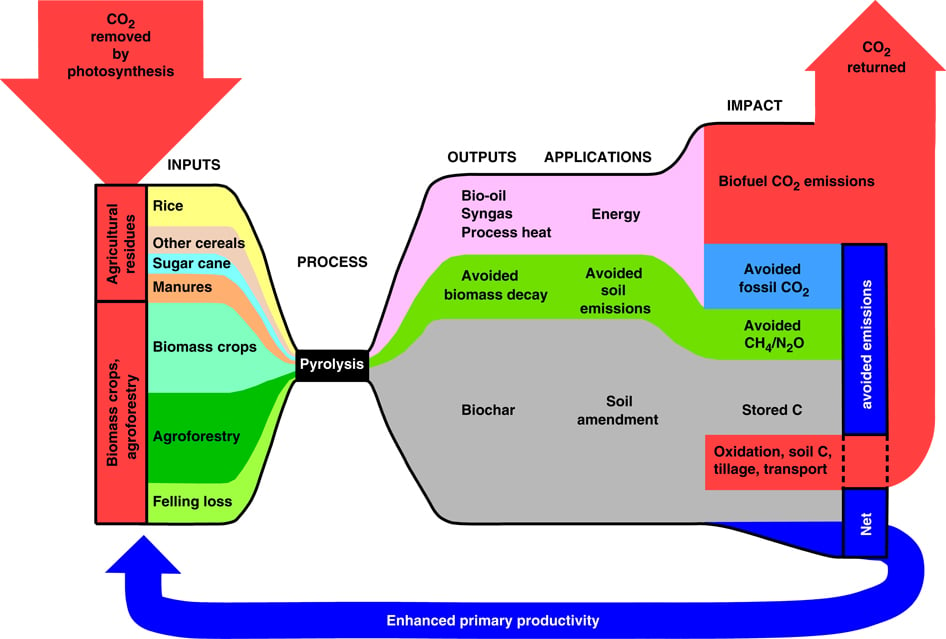
biochar-flow-chart

This is an excellent depiction of the system.  The punchline on how biochar can help relieve the pressure on our dangerously overstressed climate system is “Annual net emissions of carbon dioxide (CO2), methane and nitrous oxide could be reduced by a maximum of … 12% of current anthropogenic emissions … without endangering food security, habitat or soil conservation.”

The UK’s Department for Environment, Food and Rural Affairs (Defra) has a comprehensive complementary report that also counts the ways that biochar can assist in radically reducing greenhouse gases.   This is a rigorous review of the ins and outs of biochar, and is frankly quite conservative, but one of its conclusions remains “…in principle, biochar has a high carbon abatement efficiency and there are some potentially viable options which may deserve more careful attention…”

The very good people of the International Biochar Initiative, and others, are trying now to build a groundswell of support for this enormously beneficial approach to, among other things, in the words of Michael Pollan, resolarizing our farms and our food.  It’s not rocket science, folks.  But perhaps that’s one of the reasons that biochar is not receiving its due:  There may not be a lot of return on capital for the VC community in a manifestly low-tech system.  That’s all the more reason, then, why we need to keep this in front of policy makers and show what can and should be done.

     
    Add a comment

    Comments (8)

    1. Axel Saturday - 14 / 08 / 2010 Reply
      Biochar is nothing but pointless MUMMERY. It is quite literally a meaningless ceremony, which serves no useful purpose at al, other than to make money, based on a fraudulent premis. That is the premis that CO2 is excessive and therefor requires to be reduced, in this case by "BioChar". THIS IS FRAUD. Climate change and increased CO2 is responsible for increases in crop yields and early maturity of crops. When there is increased CO2, plants use less water. Yet the government would tax us all to bankruptcy, by putting a price on cow-farts, and fuel oil usage. The Climate Always changes, it isn’t something that a Human can significantly affect, and “fighting climate” is pointless. What we must do is WORK WITH the inevitable climate change. Know the truth about “climate change”, and don’t be filling Al Gore’s pockets with our cash. He can’t control the climate, any more than National Academy of Sciences experts, or indeed any Human Being can. For Numerous Feature length Videos on this subject, See the webpages at: http://fraudulentclimate.atspace.com
    2. Erich J. Knight Saturday - 14 / 08 / 2010 Reply
      Agriculture allowed our cultural accent and Agriculture will now prevent our descent. Wise Land management; Organic farming and afforestation can build back our soil carbon, Biochar allows the soil food web to build much more recalcitrant organic carbon, ( living biomass & Glomalins) in addition to the carbon in the biochar. Every 1 ton of Biomass yields 1/3 ton Charcoal for soil Sequestration (= to 1 Ton CO2e) + Bio-Gas & Bio-oil fuels = to 1MWh exported electricity, so is a totally virtuous, carbon negative energy cycle. Biochar viewed as soil Infrastructure; The old saw; "Feed the Soil Not the Plants" becomes; "Feed, Cloth and House the Soil, utilities included !". Free Carbon Condominiums with carboxyl group fats in the pantry and hydroxyl alcohol in the mini bar. Build it and the Wee-Beasties will come. Microbes like to sit down when they eat. By setting this table we expand husbandry to whole new orders & Kingdoms of life. ( These oxidised surface charges; carbonyl. hydroxyl, carboxylic acids, and lactones or quinones, have as well a role as signaling substances towards bacteria, fungi and plants.) This is what I try to get across to Farmers, as to how I feel about the act of returning carbon to the soil. An act of penitence and thankfulness for the civilization we have created. Farmers are the Soil Sink Bankers, once carbon has a price, they will be laughing all the way to it. Unlike CCS which only reduces emissions, biochar systems draw down CO2 every energy cycle, closing a circle back to support the soil food web. The photosynthetic "capture" collectors are up and running, the "storage" sink is in operation just under our feet. Pyrolysis conversion plants are the only infrastructure we need to build out. For those looking for an overview of biochar and its benefits, These authors have done a very nice job of distilling a great deal of information about biochar and applying it to the US context: US -Focused Biochar report: Assessment of Biochar's Benefits for the USA www.biochar-us.org/pdf%20files/biochar_report_lowres.pdf NASA’s Space Archaeology; $364K Terra Preta Program archaeologyexcavations.blogspot.com/2010/08/time-traveling-via-satellite.html Since we have filled the air , filling the seas to full, Soil is the Only Beneficial place left. Carbon to the Soil, the only ubiquitous and economic place to put it. WorldStoves in Haiti ; www.charcoalproject.org/2010/05/a-man-a-stove-a-mission/ and The Biochar Fund http://biocharfund.org/ deserves your attention and support. Exceptional results from biochar experiment in Cameroon NSF Awards $600K to BREAD: Biochar Inoculants for Enabling Smallholder Agriculture www.nsf.gov/awardsearch/showAward.do?AwardNumber=0965336
    3. Erich J. Knight Saturday - 14 / 08 / 2010 Reply
      Dear Axel, All political persuasions agree, building soil carbon is GOOD. To Hard bitten Farmers, wary of carbon regulations that only increase their costs, Building soil carbon is a savory bone, to do well while doing good. Biochar provides the tool powerful enough to cover Farming's carbon foot print while lowering cost simultaneously. 20 miles up river in Waynesboro, Virginia, I got a call from my local DuPont plant to deal with a legacy Hg problem in the Shenandoah River, very exciting, I've sent all pertinent papers and got them hooked up with JMU/ISAT university, they are hot to trot for mercury remediation, I've sent them all the recent heavy metal papers and Biochar Sorption of Contaminants www.biorenew.iastate.edu/events/biochar2010/conference-agenda/agenda-overview/breakout-session-5/agriculture-forestry-soil-science-and-environment.html presentations by Dr.Gerard Cornelissen & Ellen Graber at ISU Dr. Lima's work; *Specialized Characterization Methods for Biochar* www.biorenew.iastate.edu/events/biochar2010/conference-agenda/agenda-overview/breakout-session-4/production-and-characterization.html And at USDA; The Ultimate Trash To Treasure: *ARS Research *Turns Poultry Waste into Toxin-grabbing Char* http://www.ars.usda.gov/IS/AR/archive/jul05/char0705.htm Someone, like you, should also lay siege to the Pentagon & State dept, catapulting the ISU presentations on dioxins for a diplomatic coup-da-ta to do a large scale cleanup of 2-4D in Vietnam. The politics right now seem prime for this, to bad Hillary Clinton didn't have this card to play on her recent visit. "putting a price on cow-farts," Actually ruminant belching of methane is the problem. Again work in Japan & University of Georgia shows that a 5% feed ration of char cuts that by half, simultaneously increasing feed conversion rates , plus, then they spread the char to the field.
      • Bill Hewitt
        Bill Hewitt Sunday - 15 / 08 / 2010 Reply
        Thanks, Erich, for your responses with, as ever, lots of pertinent information on biochar and beyond.
    4. Erich J. Knight Sunday - 24 / 10 / 2010 Reply
      Hi Bill, I have been briefing Michael Pollan, starting about 6 months before his Letter to the President Elect. I have been chiding him ever since for not writing on Biochar 's potential for resolarizing the farm. He has been very supportive and encouraging about my up dates on Char developments . I have faith he will include it in the future. Even BIG AG must be seeing the writing on the wall concerning soil carbon. Particularly since the writing is on the very ivory tower walls of the major Ag universities they fund. Like ISU & U of ll; This meta-analysis of Syn-N and soil Carbon content incorporating fertilizer studies back to WWII, show our dilemma; www.agronomy.org/publications/jeq/articles/38/6/2295 N & P CYCLES TOO; Whole systems solutions based on building soil carbon take a while to filter through one's mind to see the manifold benefits. The "Eyes Glaze Over" microbial complexity, labile verses recalcitrant carbon, Cation Exchange Capacity (CEC) etc, all conspire to slow peoples comprehension . Once thought through however, the elemental carbon nature of biochar understood, soil's reduced GHG emissions and the local economic stimulus perceived, then can be added that beyond rectifying the Carbon Cycle, biochar systems serve the same healing function for the Nitrogen & Phosphorous Cycles, Toxicity in Soils & Sediments and cut the carbon foot print of livestock.by 1/2 with a 5%Char feed ration. The production of fossil fuel free ammonia & char (SynGest, www.syngest.com/ ) and the 52% conservation of NH3 in composting with chars, are just the newest pathways for the highest value use of biomass. The Soil Carbon Standard committee's work with USDA, EPA and Congressional Ag committees offers real hope, with expansion to ISO status, the world can all be on the same soil carbon page. Given the lack of leadership in pricing carbon, companies are taking charge. Look at yesterdays news on WalMart's sourcing local produce. Training small farmers etc. The old story of vendors going to Bentonville and beat with rubber hoses for the lowest price has radically changed. Now the rubber hoses are used in the name of energy efficiency and full cradle to cradle life cycle analysis. Their Sustainability Indexing Program will now take that data to formulate true carbon foot print labeling, empowering consumer's choice. I have joked with their head of sustainability that WalChar would be the first with a carbon negative label. Also on the small scale, Hillary Makes a big Announcement; State Dept. Release; 100 million clean-burning stoves in kitchens around the world. www.state.gov/r/pa/prs/ps/2010/09/147494.htm A significant aspect of low cost, Biomass cook stoves that produce Biochar is removal of BC aerosols and no respiratory disease emissions. At Scale, replacing "Three Stone" stoves the health benefits would equal eradication of Malaria & Aids combined. The Biochar Fund has doubled subsistence farmer's incomes; Exceptional results from biochar experiment in Cameroon The broad smiles of 1500 subsistence farmers say it all ( that , and the size of the Biochar corn root balls ) biocharfund.org/ NEW RESEARCH: NASA’s Space Archaeology; $364K Terra Preta Program archaeologyexcavations.blogspot.com/2010/08/time-traveling-via-satellite.html ( add http:// to links)
      • Bill Hewitt
        Bill Hewitt Monday - 25 / 10 / 2010 Reply
        Thanks, Erich. Pollan is, as we know, influential. A boost for biochar from him would be useful. Meanwhile, the revolution continues. As far as the State Dept. initiative on clean cook stoves go, it's not a little thing. It's big, good news. See Better Stoves = Less Pollution. We're also trying to radically reduce black carbon deposition, to save people's lives and to eliminate a pernicious cause of warming. The biochar stoves are an important element.
    5. greenpower Sunday - 26 / 12 / 2010 Reply
      “The Biochar Revolution” with “The Biochar Solution” I want to call this book: “All about Biochar” because “The Biochar Revolution” collects the results and best practical advice that these entrepreneurs have to offer to the biochar community. http://biochar-books.com/ In the book you will read about the challenges of designing low-emissions biochar production systems from small-scale stoves to farm-scale pyrolyzers. Another section of the book is devoted to explaining simple tests to characterize biochar and methods for conducting valid field trials.

    Add a comment


    Study International Affairs in New York City

    Author

    Bill Hewitt
    Bill Hewitt

    Bill Hewitt has been an environmental activist and professional for nearly 25 years. He was deeply involved in the battle to curtail acid rain, and was also a Sierra Club leader in New York City. He spent 11 years in public affairs for the NY State Department of Environmental Conservation, and worked on environmental issues for two NYC mayoral campaigns and a presidential campaign. He is a writer and editor and is the principal of Hewitt Communications. He has an M.S. in international affairs, has taught political science at Pace University, and has graduate and continuing education classes on climate change, sustainability, and energy and the environment at The Center for Global Affairs at NYU. His book, "A Newer World - Politics, Money, Technology, and What’s Really Being Done to Solve the Climate Crisis," will be out from the University Press of New England in December.


    Areas of Focus:
    the policy, politics, science and economics of environmental protection, sustainability, energy and climate change

    Contact