
 There’s a lot going on lately, and a fair number of calls to the Obama administration to take note and react to all of it. Nothing from Washington yet.
First, the Cuban Labor Federation came right out and announced that 1 million public sector jobs were set to be eliminated, half of these by next March (2011). This appears to be the culmination of a number of statements made by Cuban officials—including Raúl Castro—about the inefficiency of the Cuban state as it currently operates, and the need to streamline processes and let go redundant workers. It even looks like Fidel Castro might be on board with big reforms: Jeffrey Goldberg contends that in his recent extensive interviews with Fidel he asked whether the Cuban economic and political system was worth exporting, to which former President Castro replied, “The Cuban model doesn’t even work for us anymore.” (Fidel has since then agreed that he made that statement, but argued that he meant something else entirely).
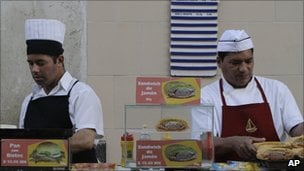
The laying off of this many government workers would be the largest public sector shift since the revolution. The state employs around 85% of Cuban workers (5.1 million people); this change will affect around one in five of these. But they will not be left out to dry: the Labor Federation explained that job options will be expanded in non-state forms, thus broadening private sector opportunities that now mostly consist of small self-employed endeavors like hair-dressing and taxi-driving. The challenge will be to make sure the jobs eliminated do not result in a massive shift of workers into Cuba’s underground economy instead.
Brazil has offered to assist on that front, and could be a very strong partner. Brazilian Foreign Minister Celso Amorim, on a visit to Havana over the weekend en route to meetings at the UN in New York, noted that he believed the planned changes to the Cuban economy would increase opportunities, and offered Brazil’s expertise given its recent successes in developing small and medium sized businesses and reducing the informal economy.
So what’s Obama’s response to all of this change? None yet, but given his penchant for interacting with private citizens in Cuba (he surprised many by responding personally to questions from Cuban blogger Yoani Sanchez at the end of last year), perhaps he’ll seize upon a recent rather odd opportunity–-an invitation from Cuban prima ballerina Alicia Alonso to visit the island with his family. It might just be wacky enough…
(Photo from BBC World)
