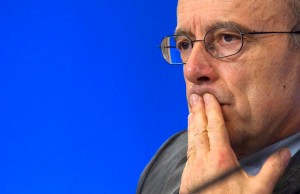
Reuters
These last several weeks Alain Juppé, French Foreign Minister, has been outspoken against the incompetence of the EU High Representative Catherine Ashton and the European External Action Service (EEAS). The latest attack was a letter sent by Juppé to Ashton on March 9th, wherein the French minister lectured Ashton on the shortfalls of the EEAS. According to Juppé’s representatives, the letter was part of a natural exercise of constructive criticism fostering debate between the EEAS and the French ministry of Foreign Affairs.
Despite the fact that Ashton has not emerged as the most polish diplomat, it is still quite inappropriate to see France attacking her this way. Back in 2009 Nicolas Sarkozy, President of France, made a choice to assure the DG Internal Market of the European Commission to Michel Barnier instead of seeking for the head of the EEAS. France is far from being a model of EU guardianship when it comes to foreign policy, as recently illustrated with the Arab Spring and the NATO mission in Libya. In both cases, France tried to maximize its interests at the expense of the EEAS and ultimately the Union.
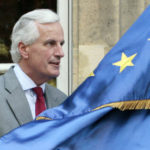
Francois Guillot/AFP/Getty Images
Following the appointments of Ms. Ashton, Mr. Van Rompuy, and Mr. Barnier, Nicolas Sarkozy declared that securing DG Internal Market was a victory for France. Sarkozy was quoted by Le Monde claiming that “the agreement on the role of Michel Barnier was sealed between Barroso and I [Sarkozy] three days ago. It’s exceptional for France. And the second victory is that our friends, the Romanians, have agriculture.” Such statement was particularly inappropriate for two reasons: first, in theory, a Commissioner is accountable to the Union and not to his/her country; second, the statement was directly addressed to the British. No statements were made about the importance of the EEAS.
In recent years, Mr. Juppé has emerged as an vocal politician considering his criticisms on several key decisions made by the ruling party of

Reuters
President Sarkozy. For example, he was critical of the bill criminalizing the denial of the Armenian genocide considering the consequence it could have on the relations with Turkey; second, he took note of the election of Vladimir Putin last Sunday, and never congratulated Putin; last, he now criticizes openly Ashton in his letter of March 9th.
Despite the criticism, Juppé called for the EEAS to become a stronger international actor as well as increase the coherence and efficiency of the external actions of the EU. He also made several propositions: first, the EEAS must be more proactive in advancing the questions of human rights in countries like Syria and Iran; second, reinforcing the EU capacities in sharing refueling airplanes as proven by the shortfalls during the Libyan mission; third, the EEAS needs to improve its competencies on core international questions such as non-proliferation, fight against terrorism, coherence in international fora.
Erkki Tuomioja, head of the Finish diplomacy, declared that Ashton has been trying her best but remains dependent on the willingness of the EU Member States, and especially the Big Three – Britain, France, and Germany. Such statement is not surprising coming from a smaller EU Member State as they have progressively become second-class citizens on foreign policy questions. This gap between the Big Three and the rest of the Union is increasingly hurting the unity of the Union on key international questions.
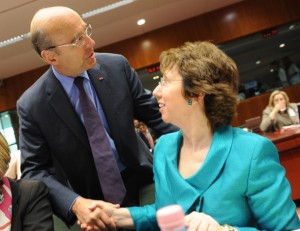
Georges Gobet/AFP/Getty Images
The claim that the EEAS has turned out as a disappointment is quite valid considering its large budget and staff. The EU could have been much more active in the Arab Spring – Tunisia and Egypt – and failed to do so. Libya was really the opportunity to redeem the EEAS and launched a CSDP mission. Ashton failed to assure a role to the EU. Now with Syria, one could expect nothing coming from the EEAS beside words. Despite the recent failures of the EEAS, for Juppé to lecture Ashton on her missteps, mistakes, and the EEAS shortcomings is an absolute aberration. France should take a clear look at its latest foreign policy decisions and see how many times since 2009 and before it has tried to empower the EEAS instead of France’s interests. Nicolas Sarkozy has proven to be a strategic world leader positioning France as a world power at the expense of the EU, as proven by the Georgia and Libyan crises among others. Ultimately, EU Member States get what they choose for. Maybe it should be time to substitute the traditional question of, how much has the EEAS done for France?, by another one, how much has France done for the EEAS?
