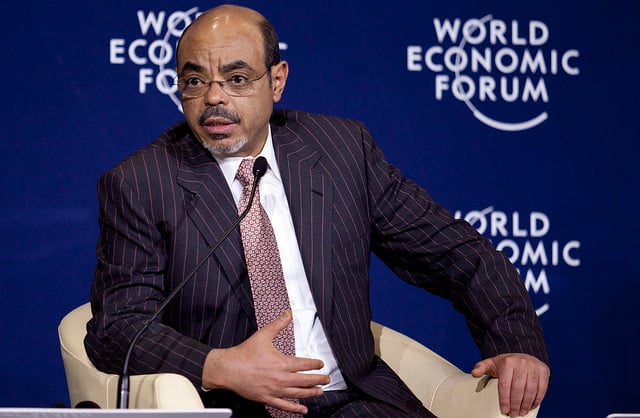
Prime Minister of Ethiopia Meles Zenawi, seen here at a World Economic Forum (WEF) summit in the Ethiopian capital of Addis Ababa in May 2012. Zenawi has not been seen publicly since June, and his absence has set off a succession struggle in the strategically-placed East African nation. Photo: WEF
Ethiopia, the second-most populous country on the African continent (behind only Nigeria), is looked to as a relatively strong and stable presence in a volatile region. Its cooperation is vital to security concerns in the region, especially as a barrier to the spread of radical Islamism and terrorism from neighboring Somalia. The U.S. has collaborated directly with Ethiopians on combat missions into Somalia.
Ethiopia’s Prime Minister Meles Zenawi has been relied on as a regional power-broker and calming influence. The Financial Times labeled Zenawi “one of east Africa’s diplomatic and security linchpins,” and consider that his “vision and diplomacy” have kept the area from becoming completely unhinged.
Under Zenawi’s leadership Ethiopia has attracted significant foreign aid, receiving more than any other African country. In 2011, the U.S. Agency for International Development provided an astounding $675 million in contributions; Tobias Hagmann of the University of California-Berkeley identified Ethiopia as “a darling of the donor community,” a view based on “the portrayal of Ethiopia as a strong and stable government in a region riddled with political upheaval.”
Ethiopia is also considered a federal democracy; unfortunately it seems democracy exists there in name only. Hagmann says in reality Ethiopia is a “highly centralized one-party state,” where those in power tightly control all public institutions throughout the country. Critics of the regime say that Zenawi has acquired a near-exclusive hold on power and the regime cracks down harshly on opposition.
A power struggle may be developing as well. Zenawi has been persona non grata over the past two months, having not made any public appearances since June (unusual for the highly prominent and oft-visible leader). While government officials claim he is recovering from an illness, Zenawi’s disappearance has set off “a covert succession struggle that threatens to fracture the regime and expose ethnic faultlines.”
Yet aid dollars keep pouring in as if nothing is wrong. While the United States tries to encourage openness and fairness in government and respect for citizen rights, in this case it continues to provide aid in spite of stark evidence that Ethiopian society is anything but open. A succession struggle must be alarming to Western governments who have come to rely on Zenawi as an ally in the fight against terrorism. Perhaps the U.S. and others feel that as authoritarian as he may be, whoever comes next may not be so cooperative (in other words, it’s preferable to work with the devil you know).
The U.S. has a long history (unfortunately) of speaking eloquently about democracy while supporting leaders who claim to be democratic, but do not practice what they preach. Ethiopia may be another example. Developed nations — aid providers — should be more critical here. A strong Ethiopia is certainly integral to the region’s stability, but this should not be accomplished at the expense of political freedoms and human rights. Security and democracy don’t have to be mutually exclusive — you shouldn’t have to ignore one to get the other.
